The Complete Guide to Sofa Fabrics: What Every Mauritian Buyer Should Know
When most customers shop for a sofa, they usually start with two questions: Is it comfortable? and Does it look good?
That is completely understandable.
At TFP, comfort is usually the first priority, followed by colour and appearance, then price, durability and ease of cleaning. Fabric type itself often comes much later in the decision.
The problem is that sofa fabric affects much more than appearance.
It affects:
- How warm the sofa feels after two hours of sitting.
- How easily spills can be cleaned.
- How much pet hair collects on the surface.
- How quickly the fabric fades near a sunny window.
- How well the sofa handles Mauritius's humidity.
- How long the upholstery continues to look presentable.
That means the best-looking fabric in a showroom is not automatically the best fabric for your home.
The right sofa fabric is the one that still works after the showroom impression is gone and real life begins.
First: Sofa Fabric Names Can Be Misleading
One of the most useful things a sofa buyer can do is ask:
"What is the actual fibre composition?"
Terms such as linen, velvet and leather-look often describe appearance and texture rather than the exact material composition.
For example, many linen-look sofas use polyester or blended fabrics rather than 100% natural linen. Likewise, velvet describes a pile structure and surface feel, not necessarily a specific natural fibre.
Why does this matter?
Because the actual fibre content affects:
- Heat retention.
- Moisture absorption.
- Stain resistance.
- Cleaning requirements.
- Durability.
- Humidity performance.
Before buying, check both the product description and the care label where available.
Which Sofa Fabric Is Best for Mauritius?
There is no single winner for every household.
But for most Mauritian family homes, polyester or performance fabric is the strongest all-round option because it balances durability, stain resistance, price, cleaning practicality and reasonable breathability.
For customers prioritising a cooler sitting experience in a home without air conditioning, linen-look fabric is another strong choice.
Velvet and genuine leather can both be excellent, but they suit more specific homes and lifestyles.
PU leather deserves the most caution in Mauritius because heat retention and humidity-related peeling are common complaints.
Why Mauritius's Climate Matters So Much
Mauritius is warm, humid and often naturally ventilated.
That makes sofa upholstery behave differently from the same material in a cool, air-conditioned environment.
The main climate factors are:
- Heat during long sitting sessions.
- Persistent humidity.
- Open windows bringing in dust.
- Strong tropical sunlight.
- Coastal salt air affecting some metal components.
Linen-look and open-weave polyester blends generally feel cooler, while PU leather and genuine leather tend to feel warmer during prolonged sitting. Velvet can also feel noticeably warm in rooms without air conditioning.
For Homes Without Air Conditioning
Breathable woven fabric is generally the safest choice.
TFP's research guidance favours:
- Polyester fabric.
- Performance fabric.
- Linen-look polyester blends.
These options manage Mauritius's heat more comfortably than PU leather or velvet during long sitting sessions.
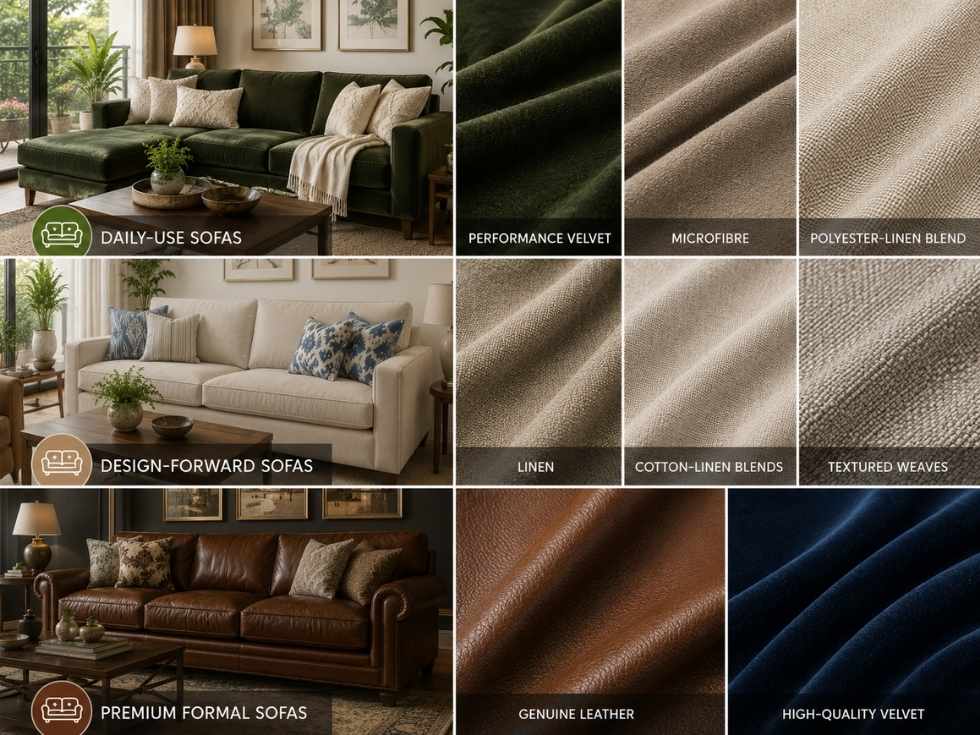
Polyester and Performance Fabric: The Best All-Rounder
Polyester and performance fabrics are the volume leaders for good reason.
They are practical, widely available and generally well suited to family life in Mauritius.
Main Advantages
- Good stain resistance.
- Strong everyday durability.
- Relatively easy cleaning.
- Accessible price points.
- Wide colour selection.
- Better breathability than PU leather.
They are especially suitable for:
- Families with children.
- Pet owners.
- Heavy daily use.
- Budget-conscious households.
The main weaknesses are that lower-quality polyester blends can pill over time, absorb odours and fade if exposed to strong direct sunlight.
Linen-Look Fabric: Cooler and More Relaxed
Most linen-look sofas in mainstream furniture retail are not necessarily made from 100% natural linen.
They are often polyester-based or blended fabrics designed to reproduce the natural woven appearance of linen while being easier to maintain.
Why It Works Well in Mauritius
Polyester linen-look fabric generally handles humidity better than natural linen and remains more practical for daily family use.
It is also cooler than velvet and PU leather during long sitting sessions.
That makes it particularly suitable for:
- Homes without air conditioning.
- Warm living rooms.
- Families wanting a natural aesthetic.
- Small apartments where lighter textures help the room feel airy.
What to Watch Out For
Loose linen-style weaves can snag more easily around pets.
Some lighter linen-look fabrics can also show watermarks or stains more clearly than tightly woven performance fabric.
Velvet: Beautiful, Luxurious — and More Demanding
Velvet has grown significantly in popularity in Mauritius.
Its appeal is easy to understand.
Velvet provides:
- A luxury appearance.
- Very soft first-contact feel.
- Rich colour depth.
- Strong visual impact in jewel tones.
Emerald green, navy and burgundy are especially striking on velvet.
But the same material that looks dramatic in a showroom requires more attention at home.
Velvet's Main Practical Disadvantages
- Feels warmer during long sitting.
- Traps dust.
- Collects pet hair.
- Can flatten in high-contact areas.
- Can show watermarks.
- Dark colours can fade visibly in direct sun.
Velvet is therefore better suited to:
- Air-conditioned living rooms.
- Formal living spaces.
- Lower-traffic households.
- Customers who prioritise appearance and accept higher maintenance.
It is less practical for young children, cats and heavy everyday use.
How to Clean Velvet Safely
Vacuum gently with a soft upholstery attachment.
If a spill occurs:
- Blot immediately.
- Do not rub.
- Avoid excessive water.
- Avoid harsh DIY chemicals.
For significant staining, professional cleaning is generally safer than aggressive home treatment.
PU Leather: Easy to Wipe, Harder to Live With in the Heat
PU leather remains popular because it gives a leather-like appearance at a much lower price than genuine leather.
It is also easy to wipe clean.
But in Mauritius, it has two major weaknesses:
- Heat retention.
- Peeling in humid conditions.
In warm rooms without air conditioning, PU leather can feel hot and sticky during extended sitting.
Humidity can also accelerate surface deterioration and peeling. Peeling may begin within around 1–3 years in humid, non-air-conditioned conditions, although actual lifespan varies significantly with material quality, room conditions and use.
This means PU leather is best chosen with clear expectations rather than simply because it looks like genuine leather.
Genuine Leather: Premium, Durable and Better With Age
Genuine leather behaves very differently from PU leather.
Rather than peeling as a synthetic surface layer fails, quality leather develops a natural patina over time.
Its advantages include:
- Longer lifespan.
- Better breathability than PU leather.
- Easy surface cleaning.
- Premium appearance.
- Ageing that can add character rather than simply look worn.
The trade-offs are:
- Higher purchase price.
- Need for occasional conditioning.
- Visible scratching.
- Potential fading from strong direct sunlight.
For customers willing to invest and maintain it properly, genuine leather can justify the premium through longevity.
Microfibre: One of the Most Practical Choices for Families and Pets
Microfibre deserves more attention from practical sofa buyers.
It is tightly woven, generally stain resistant and relatively easy to clean.
That makes it particularly useful for:
- Young children.
- Dogs.
- Cats.
- Busy family living rooms.
Compared with velvet or loose-weave linen-look fabric, microfibre is less likely to trap hair or snag easily.
What Is the Best Sofa Fabric for Families With Children?
For young families, the safest choices are generally:
- Performance polyester.
- Tightly woven synthetic fabric.
- Microfibre.
Common family stains include juice, sauce, chocolate and curry.
Tightly woven synthetic fabrics are easier to clean than delicate velvet or loose natural fabrics.
Choose Mid-Tone Colours
Grey, beige and brown are practical because they hide everyday marks better than very pale or very dark alternatives.
Very light sofas may show every spill.
Very dark sofas can make dust, lint and light-coloured marks more visible than expected.
Fabric Protection Is Worth Considering
For family homes, professional fabric protection can provide valuable extra time to blot spills before they penetrate deeply.
It does not make a sofa stain-proof, but it can make daily maintenance easier.
Removable Covers Change the Equation
If a sofa has genuinely removable and washable cushion covers, this can be a major practical advantage.
Instead of relying only on spot cleaning, covers can be removed and cleaned according to the manufacturer's care instructions.
What Is the Best Sofa Fabric for Pets?
Pet households should focus on:
- Claw resistance.
- Hair removal.
- Easy cleaning.
- Colour practicality.
Cats
Tightly woven microfibre is one of the better options because claws have fewer loose fibres to catch.
Dogs
Performance polyester and microfibre are generally practical because hair is easier to remove and everyday marks are easier to clean.
Materials to Be Careful With
- Velvet — traps hair.
- Chenille — can trap dust and pet hair.
- Loose linen-look weave — more vulnerable to snagging.
- PU leather — claw damage can initiate peeling.
For multi-pet households, performance polyester or microfibre is generally the most practical compromise.
Dust, Allergies and Open Windows
Mauritian homes often rely on natural ventilation, which means windows remain open and airborne dust enters the living room more easily.
Velvet and chenille tend to trap more dust than flatter woven fabrics.
A useful maintenance routine is:
- Vacuum most sofas weekly.
- Vacuum velvet more frequently where dust exposure is high.
- Use an upholstery attachment.
- Clean underneath loose cushions.
The Biggest Cleaning Mistake: Too Much Water or Harsh Chemicals
People often assume that a stronger cleaner will produce a cleaner sofa.
It can do the opposite.
Too much water can leave watermarks and create slow-drying dampness.
Harsh chemicals can damage fibres or change the fabric colour.
Always:
- Check the manufacturer's care instructions.
- Test cleaning products on a hidden area first.
- Blot rather than scrub aggressively.
Professional cleaning every 12–18 months is a reasonable general interval for heavily used sofas, with more frequent attention for very light fabrics or high-use family homes.
How to Stop Your Sofa From Fading
Mauritius's sunlight can be extremely strong near large windows and sliding doors.
Dark velvet and unprotected natural fabrics show fading particularly clearly.
Light neutral fabrics may still fade, but the change tends to be less visually dramatic.
Protect sun-exposed sofas with:
- Curtains.
- Blinds.
- UV-filtering window film.
- Alternative sofa placement where possible.
How to Protect a Sofa From Humidity
Humidity problems often develop when a sofa sits in a poorly ventilated room or directly against a damp wall.
Basic precautions include:
- Keep the room ventilated.
- Do not push upholstery tightly against visibly damp walls.
- Allow air to circulate around and behind the sofa.
- Air out the room regularly.
This is especially relevant for velvet, natural linen and poorly ventilated coastal homes.
How Long Should a Sofa Fabric Last?
Sofa lifespan depends on far more than the fabric name.
Usage intensity, frame quality, foam construction, fabric specification, sunlight, children, pets and maintenance all matter.
General guidance is as follows:
| Sofa Type | General Lifespan Guidance |
|---|---|
| Budget fabric sofa | Around 3–5 years |
| Quality fabric sofa | Around 6–10 years |
| Velvet sofa | Around 5–7 years, with pile flattening possible in heavy-use areas |
| PU leather sofa | Around 2–4 years under humid conditions, with peeling as a key risk |
| Genuine leather sofa | 10+ years with appropriate care |
These are broad guidance ranges rather than guarantees and should be confirmed against TFP's own data before publication.
Fabric Quality Matters More Than the Fabric Name
This is one of the most important points in the entire guide.
A high-quality polyester fabric can outperform a low-quality fabric marketed as premium.
Likewise, an expensive-looking velvet sofa is not automatically more durable than a well-specified woven fabric sofa.
What matters includes:
- Fibre composition.
- Weave density.
- Rub resistance.
- Colour fastness.
- Pile quality for velvet.
- Backing construction.
Premium appearance and premium durability are not the same thing.
What Is a Martindale Rating?
The Martindale test measures how resistant an upholstery fabric is to repeated rubbing and wear.
General industry guidance is:
- Normal residential use: around 15,000+ rubs.
- Heavy family use: around 30,000+ rubs.
- Commercial use: around 100,000+ rubs.
Whether TFP currently publishes or uses Martindale ratings should be confirmed before including this as a TFP-specific claim.
Comfort: Fabric Matters, But It Is Not Everything
Velvet usually feels softest when you first touch it.
But after two to four hours in a warm room, linen-look and breathable polyester blends are generally more comfortable because they retain less heat.
That said, the sofa's:
- Frame construction.
- Foam density.
- Seat depth.
- Back support.
- Suspension system.
matter just as much — and often more — for long-term comfort.
Do not judge a sofa only by its upholstery.
Which Sofa Fabric Works Best With Different Interior Styles?
| Interior Style | Suitable Sofa Direction |
|---|---|
| Minimalist | Light neutral fabric |
| Warm family home | Beige or brown polyester / linen-look |
| Hotel-inspired | Velvet in richer tones |
| Luxury / glam | Velvet or genuine leather |
| Small apartment | Light-coloured, low-profile fabric sofa |
For most homes, timeless neutral upholstery is the safer long-term investment.
Trends can then be introduced through cushions, throws and accessories that are much cheaper to replace.
Which Fabric Should Different Households Choose?
| Household / Room | Recommended Starting Point |
|---|---|
| Hot living room without AC | Polyester or linen-look |
| Air-conditioned living room | Velvet or genuine leather also viable |
| Young children | Performance polyester |
| Cats | Tightly woven microfibre |
| Dogs | Performance polyester / microfibre |
| Coastal home | Moisture-resistant performance fabric |
| Rental property | Budget-friendly durable polyester |
| Formal living room | Velvet or genuine leather |
| Main daily family sofa | Performance polyester |
| Luxury statement sofa | Velvet or genuine leather |
| Small apartment | Light polyester or linen-look |
| Elderly household | Easy-clean polyester with supportive cushioning |
These recommendations follow lifestyle-based guidance rather than assuming one fabric works for everyone.
The Biggest Sofa Fabric Buying Mistakes
Mistake #1: Choosing Only by Appearance
The sofa may look beautiful in the showroom but feel too warm, stain too easily or require more maintenance than your household can realistically provide.
Mistake #2: Ignoring Mauritius's Climate
PU leather in an uncooled room and dark velvet beside a sunny sliding door are two examples where local conditions can completely change the ownership experience.
Mistake #3: Ignoring Children and Pets
The material should reflect who actually uses the sofa.
Mistake #4: Assuming PU Leather Behaves Like Genuine Leather
The appearance may be similar when new, but the long-term behaviour can be very different.
Mistake #5: Not Checking Fibre Composition
A product name does not always tell you what the upholstery is actually made from.
Mistake #6: Buying Velvet Without Understanding the Maintenance
Velvet can be a fantastic choice for the right household, but it is not a zero-maintenance family fabric.
Mistake #7: Choosing the Cheapest Fabric
Low price can become poor value if the fabric pills, fades or looks worn much sooner than expected.
Choosing purely by appearance, ignoring climate and ignoring children/pets are the three most important mistakes to avoid.
Questions to Ask Before Buying a Sofa
Before choosing, ask the salesperson:
- What is the actual fibre composition?
- Is this fabric suitable for heavy daily use?
- How should it be cleaned?
- Is it suitable for a home without air conditioning?
- Does the colour fade in direct sunlight?
- Are the cushion covers removable?
- Is a Martindale rating available?
- What warranty applies to the sofa?
Then physically:
- Feel the fabric.
- Sit long enough to assess heat and comfort.
- Inspect the weave.
- Look at how tightly the upholstery is fitted.
- Check whether removable covers are genuinely designed for washing.
Choosing a Sofa at TFP
To keep this guide useful as individual collections change, the most relevant TFP categories are:
- Fabric sofas.
- Velvet sofas.
- Recliner sofas.
- L-shaped sofas.
- Sofa beds.
- Sectional sofas.
- Genuine leather sofas where available.
Model references are kept category-based so the article remains evergreen.
TFP's Final Verdict: Choose the Fabric for the Life You Actually Live
There is no sofa fabric that wins every comparison.
Velvet can look spectacular.
Genuine leather can last for years.
Linen-look can feel cooler.
Microfibre can make pet ownership easier.
Performance polyester can handle the everyday reality of a busy family home better than many more glamorous alternatives.
So before asking:
"Which sofa fabric looks best?"
Also ask:
- Is my living room air-conditioned?
- Do children use this sofa every day?
- Do I have cats or dogs?
- Does direct sunlight reach the sofa?
- How much cleaning am I realistically willing to do?
- What is the actual fibre composition?
- How durable is the specific fabric?
The answer to those questions should guide the fabric decision more than appearance alone.
The best sofa fabric for a Mauritian home is the one that fits your household, handles our heat and humidity, suits your maintenance habits, and is made to a quality that actually holds up — not just the one that looks best in the showroom.
The Complete Guide to Sofa Fabrics: What Every Mauritian Buyer Should Know
When most customers shop for a sofa, they usually start with two questions: Is it comfortable? and Does it look good?
That is completely understandable.
At TFP, comfort is usually the first priority, followed by colour and appearance, then price, durability and ease of cleaning. Fabric type itself often comes much later in the decision.
The problem is that sofa fabric affects much more than appearance.
It affects:
- How warm the sofa feels after two hours of sitting.
- How easily spills can be cleaned.
- How much pet hair collects on the surface.
- How quickly the fabric fades near a sunny window.
- How well the sofa handles Mauritius's humidity.
- How long the upholstery continues to look presentable.
That means the best-looking fabric in a showroom is not automatically the best fabric for your home.
The right sofa fabric is the one that still works after the showroom impression is gone and real life begins.
First: Sofa Fabric Names Can Be Misleading
One of the most useful things a sofa buyer can do is ask:
"What is the actual fibre composition?"
Terms such as linen, velvet and leather-look often describe appearance and texture rather than the exact material composition.
For example, many linen-look sofas use polyester or blended fabrics rather than 100% natural linen. Likewise, velvet describes a pile structure and surface feel, not necessarily a specific natural fibre.
Why does this matter?
Because the actual fibre content affects:
- Heat retention.
- Moisture absorption.
- Stain resistance.
- Cleaning requirements.
- Durability.
- Humidity performance.
Before buying, check both the product description and the care label where available.
Which Sofa Fabric Is Best for Mauritius?
There is no single winner for every household.
But for most Mauritian family homes, polyester or performance fabric is the strongest all-round option because it balances durability, stain resistance, price, cleaning practicality and reasonable breathability.
For customers prioritising a cooler sitting experience in a home without air conditioning, linen-look fabric is another strong choice.
Velvet and genuine leather can both be excellent, but they suit more specific homes and lifestyles.
PU leather deserves the most caution in Mauritius because heat retention and humidity-related peeling are common complaints.
Why Mauritius's Climate Matters So Much
Mauritius is warm, humid and often naturally ventilated.
That makes sofa upholstery behave differently from the same material in a cool, air-conditioned environment.
The main climate factors are:
- Heat during long sitting sessions.
- Persistent humidity.
- Open windows bringing in dust.
- Strong tropical sunlight.
- Coastal salt air affecting some metal components.
Linen-look and open-weave polyester blends generally feel cooler, while PU leather and genuine leather tend to feel warmer during prolonged sitting. Velvet can also feel noticeably warm in rooms without air conditioning.
For Homes Without Air Conditioning
Breathable woven fabric is generally the safest choice.
TFP's research guidance favours:
- Polyester fabric.
- Performance fabric.
- Linen-look polyester blends.
These options manage Mauritius's heat more comfortably than PU leather or velvet during long sitting sessions.
Polyester and Performance Fabric: The Best All-Rounder
Polyester and performance fabrics are the volume leaders for good reason.
They are practical, widely available and generally well suited to family life in Mauritius.
Main Advantages
- Good stain resistance.
- Strong everyday durability.
- Relatively easy cleaning.
- Accessible price points.
- Wide colour selection.
- Better breathability than PU leather.
They are especially suitable for:
- Families with children.
- Pet owners.
- Heavy daily use.
- Budget-conscious households.
The main weaknesses are that lower-quality polyester blends can pill over time, absorb odours and fade if exposed to strong direct sunlight.
Linen-Look Fabric: Cooler and More Relaxed
Most linen-look sofas in mainstream furniture retail are not necessarily made from 100% natural linen.
They are often polyester-based or blended fabrics designed to reproduce the natural woven appearance of linen while being easier to maintain.
Why It Works Well in Mauritius
Polyester linen-look fabric generally handles humidity better than natural linen and remains more practical for daily family use.
It is also cooler than velvet and PU leather during long sitting sessions.
That makes it particularly suitable for:
- Homes without air conditioning.
- Warm living rooms.
- Families wanting a natural aesthetic.
- Small apartments where lighter textures help the room feel airy.
What to Watch Out For
Loose linen-style weaves can snag more easily around pets.
Some lighter linen-look fabrics can also show watermarks or stains more clearly than tightly woven performance fabric.
Velvet: Beautiful, Luxurious — and More Demanding
Velvet has grown significantly in popularity in Mauritius.
Its appeal is easy to understand.
Velvet provides:
- A luxury appearance.
- Very soft first-contact feel.
- Rich colour depth.
- Strong visual impact in jewel tones.
Emerald green, navy and burgundy are especially striking on velvet.
But the same material that looks dramatic in a showroom requires more attention at home.
Velvet's Main Practical Disadvantages
- Feels warmer during long sitting.
- Traps dust.
- Collects pet hair.
- Can flatten in high-contact areas.
- Can show watermarks.
- Dark colours can fade visibly in direct sun.
Velvet is therefore better suited to:
- Air-conditioned living rooms.
- Formal living spaces.
- Lower-traffic households.
- Customers who prioritise appearance and accept higher maintenance.
It is less practical for young children, cats and heavy everyday use.
How to Clean Velvet Safely
Vacuum gently with a soft upholstery attachment.
If a spill occurs:
- Blot immediately.
- Do not rub.
- Avoid excessive water.
- Avoid harsh DIY chemicals.
For significant staining, professional cleaning is generally safer than aggressive home treatment.
PU Leather: Easy to Wipe, Harder to Live With in the Heat
PU leather remains popular because it gives a leather-like appearance at a much lower price than genuine leather.
It is also easy to wipe clean.
But in Mauritius, it has two major weaknesses:
- Heat retention.
- Peeling in humid conditions.
In warm rooms without air conditioning, PU leather can feel hot and sticky during extended sitting.
Humidity can also accelerate surface deterioration and peeling. Peeling may begin within around 1–3 years in humid, non-air-conditioned conditions, although actual lifespan varies significantly with material quality, room conditions and use.
This means PU leather is best chosen with clear expectations rather than simply because it looks like genuine leather.
Genuine Leather: Premium, Durable and Better With Age
Genuine leather behaves very differently from PU leather.
Rather than peeling as a synthetic surface layer fails, quality leather develops a natural patina over time.
Its advantages include:
- Longer lifespan.
- Better breathability than PU leather.
- Easy surface cleaning.
- Premium appearance.
- Ageing that can add character rather than simply look worn.
The trade-offs are:
- Higher purchase price.
- Need for occasional conditioning.
- Visible scratching.
- Potential fading from strong direct sunlight.
For customers willing to invest and maintain it properly, genuine leather can justify the premium through longevity.
Microfibre: One of the Most Practical Choices for Families and Pets
Microfibre deserves more attention from practical sofa buyers.
It is tightly woven, generally stain resistant and relatively easy to clean.
That makes it particularly useful for:
- Young children.
- Dogs.
- Cats.
- Busy family living rooms.
Compared with velvet or loose-weave linen-look fabric, microfibre is less likely to trap hair or snag easily.
What Is the Best Sofa Fabric for Families With Children?
For young families, the safest choices are generally:
- Performance polyester.
- Tightly woven synthetic fabric.
- Microfibre.
Common family stains include juice, sauce, chocolate and curry.
Tightly woven synthetic fabrics are easier to clean than delicate velvet or loose natural fabrics.
Choose Mid-Tone Colours
Grey, beige and brown are practical because they hide everyday marks better than very pale or very dark alternatives.
Very light sofas may show every spill.
Very dark sofas can make dust, lint and light-coloured marks more visible than expected.
Fabric Protection Is Worth Considering
For family homes, professional fabric protection can provide valuable extra time to blot spills before they penetrate deeply.
It does not make a sofa stain-proof, but it can make daily maintenance easier.
Removable Covers Change the Equation
If a sofa has genuinely removable and washable cushion covers, this can be a major practical advantage.
Instead of relying only on spot cleaning, covers can be removed and cleaned according to the manufacturer's care instructions.
What Is the Best Sofa Fabric for Pets?
Pet households should focus on:
- Claw resistance.
- Hair removal.
- Easy cleaning.
- Colour practicality.
Cats
Tightly woven microfibre is one of the better options because claws have fewer loose fibres to catch.
Dogs
Performance polyester and microfibre are generally practical because hair is easier to remove and everyday marks are easier to clean.
Materials to Be Careful With
- Velvet — traps hair.
- Chenille — can trap dust and pet hair.
- Loose linen-look weave — more vulnerable to snagging.
- PU leather — claw damage can initiate peeling.
For multi-pet households, performance polyester or microfibre is generally the most practical compromise.
Dust, Allergies and Open Windows
Mauritian homes often rely on natural ventilation, which means windows remain open and airborne dust enters the living room more easily.
Velvet and chenille tend to trap more dust than flatter woven fabrics.
A useful maintenance routine is:
- Vacuum most sofas weekly.
- Vacuum velvet more frequently where dust exposure is high.
- Use an upholstery attachment.
- Clean underneath loose cushions.
The Biggest Cleaning Mistake: Too Much Water or Harsh Chemicals
People often assume that a stronger cleaner will produce a cleaner sofa.
It can do the opposite.
Too much water can leave watermarks and create slow-drying dampness.
Harsh chemicals can damage fibres or change the fabric colour.
Always:
- Check the manufacturer's care instructions.
- Test cleaning products on a hidden area first.
- Blot rather than scrub aggressively.
Professional cleaning every 12–18 months is a reasonable general interval for heavily used sofas, with more frequent attention for very light fabrics or high-use family homes.
How to Stop Your Sofa From Fading
Mauritius's sunlight can be extremely strong near large windows and sliding doors.
Dark velvet and unprotected natural fabrics show fading particularly clearly.
Light neutral fabrics may still fade, but the change tends to be less visually dramatic.
Protect sun-exposed sofas with:
- Curtains.
- Blinds.
- UV-filtering window film.
- Alternative sofa placement where possible.
How to Protect a Sofa From Humidity
Humidity problems often develop when a sofa sits in a poorly ventilated room or directly against a damp wall.
Basic precautions include:
- Keep the room ventilated.
- Do not push upholstery tightly against visibly damp walls.
- Allow air to circulate around and behind the sofa.
- Air out the room regularly.
This is especially relevant for velvet, natural linen and poorly ventilated coastal homes.
How Long Should a Sofa Fabric Last?
Sofa lifespan depends on far more than the fabric name.
Usage intensity, frame quality, foam construction, fabric specification, sunlight, children, pets and maintenance all matter.
General guidance is as follows:
| Sofa Type | General Lifespan Guidance |
|---|---|
| Budget fabric sofa | Around 3–5 years |
| Quality fabric sofa | Around 6–10 years |
| Velvet sofa | Around 5–7 years, with pile flattening possible in heavy-use areas |
| PU leather sofa | Around 2–4 years under humid conditions, with peeling as a key risk |
| Genuine leather sofa | 10+ years with appropriate care |
These are broad guidance ranges rather than guarantees and should be confirmed against TFP's own data before publication.
Fabric Quality Matters More Than the Fabric Name
This is one of the most important points in the entire guide.
A high-quality polyester fabric can outperform a low-quality fabric marketed as premium.
Likewise, an expensive-looking velvet sofa is not automatically more durable than a well-specified woven fabric sofa.
What matters includes:
- Fibre composition.
- Weave density.
- Rub resistance.
- Colour fastness.
- Pile quality for velvet.
- Backing construction.
Premium appearance and premium durability are not the same thing.
What Is a Martindale Rating?
The Martindale test measures how resistant an upholstery fabric is to repeated rubbing and wear.
General industry guidance is:
- Normal residential use: around 15,000+ rubs.
- Heavy family use: around 30,000+ rubs.
- Commercial use: around 100,000+ rubs.
Whether TFP currently publishes or uses Martindale ratings should be confirmed before including this as a TFP-specific claim.
Comfort: Fabric Matters, But It Is Not Everything
Velvet usually feels softest when you first touch it.
But after two to four hours in a warm room, linen-look and breathable polyester blends are generally more comfortable because they retain less heat.
That said, the sofa's:
- Frame construction.
- Foam density.
- Seat depth.
- Back support.
- Suspension system.
matter just as much — and often more — for long-term comfort.
Do not judge a sofa only by its upholstery.
Which Sofa Fabric Works Best With Different Interior Styles?
| Interior Style | Suitable Sofa Direction |
|---|---|
| Minimalist | Light neutral fabric |
| Warm family home | Beige or brown polyester / linen-look |
| Hotel-inspired | Velvet in richer tones |
| Luxury / glam | Velvet or genuine leather |
| Small apartment | Light-coloured, low-profile fabric sofa |
For most homes, timeless neutral upholstery is the safer long-term investment.
Trends can then be introduced through cushions, throws and accessories that are much cheaper to replace.
Which Fabric Should Different Households Choose?
| Household / Room | Recommended Starting Point |
|---|---|
| Hot living room without AC | Polyester or linen-look |
| Air-conditioned living room | Velvet or genuine leather also viable |
| Young children | Performance polyester |
| Cats | Tightly woven microfibre |
| Dogs | Performance polyester / microfibre |
| Coastal home | Moisture-resistant performance fabric |
| Rental property | Budget-friendly durable polyester |
| Formal living room | Velvet or genuine leather |
| Main daily family sofa | Performance polyester |
| Luxury statement sofa | Velvet or genuine leather |
| Small apartment | Light polyester or linen-look |
| Elderly household | Easy-clean polyester with supportive cushioning |
These recommendations follow lifestyle-based guidance rather than assuming one fabric works for everyone.
The Biggest Sofa Fabric Buying Mistakes
Mistake #1: Choosing Only by Appearance
The sofa may look beautiful in the showroom but feel too warm, stain too easily or require more maintenance than your household can realistically provide.
Mistake #2: Ignoring Mauritius's Climate
PU leather in an uncooled room and dark velvet beside a sunny sliding door are two examples where local conditions can completely change the ownership experience.
Mistake #3: Ignoring Children and Pets
The material should reflect who actually uses the sofa.
Mistake #4: Assuming PU Leather Behaves Like Genuine Leather
The appearance may be similar when new, but the long-term behaviour can be very different.
Mistake #5: Not Checking Fibre Composition
A product name does not always tell you what the upholstery is actually made from.
Mistake #6: Buying Velvet Without Understanding the Maintenance
Velvet can be a fantastic choice for the right household, but it is not a zero-maintenance family fabric.
Mistake #7: Choosing the Cheapest Fabric
Low price can become poor value if the fabric pills, fades or looks worn much sooner than expected.
Choosing purely by appearance, ignoring climate and ignoring children/pets are the three most important mistakes to avoid.
Questions to Ask Before Buying a Sofa
Before choosing, ask the salesperson:
- What is the actual fibre composition?
- Is this fabric suitable for heavy daily use?
- How should it be cleaned?
- Is it suitable for a home without air conditioning?
- Does the colour fade in direct sunlight?
- Are the cushion covers removable?
- Is a Martindale rating available?
- What warranty applies to the sofa?
Then physically:
- Feel the fabric.
- Sit long enough to assess heat and comfort.
- Inspect the weave.
- Look at how tightly the upholstery is fitted.
- Check whether removable covers are genuinely designed for washing.
Choosing a Sofa at TFP
To keep this guide useful as individual collections change, the most relevant TFP categories are:
- Fabric sofas.
- Velvet sofas.
- Recliner sofas.
- L-shaped sofas.
- Sofa beds.
- Sectional sofas.
- Genuine leather sofas where available.
Model references are kept category-based so the article remains evergreen.
TFP's Final Verdict: Choose the Fabric for the Life You Actually Live
There is no sofa fabric that wins every comparison.
Velvet can look spectacular.
Genuine leather can last for years.
Linen-look can feel cooler.
Microfibre can make pet ownership easier.
Performance polyester can handle the everyday reality of a busy family home better than many more glamorous alternatives.
So before asking:
"Which sofa fabric looks best?"
Also ask:
- Is my living room air-conditioned?
- Do children use this sofa every day?
- Do I have cats or dogs?
- Does direct sunlight reach the sofa?
- How much cleaning am I realistically willing to do?
- What is the actual fibre composition?
- How durable is the specific fabric?
The answer to those questions should guide the fabric decision more than appearance alone.
The best sofa fabric for a Mauritian home is the one that fits your household, handles our heat and humidity, suits your maintenance habits, and is made to a quality that actually holds up — not just the one that looks best in the showroom.