How Extendable Dining Tables Help You Save Space
A practical Mauritius guide to choosing an extendable dining table that stays compact every day and gives you extra seating when family and guests arrive
A large dining table sounds useful until you realise that most days, half of it is empty.
For many Mauritian families, the dining table only needs extra seating occasionally — when relatives visit, during Sunday lunches, festive periods, weddings, Christmas, New Year or Eid gatherings.
The rest of the time, that oversized fixed table still occupies the same amount of floor space.
That is exactly where an extendable dining table becomes useful.
It gives you a compact everyday table for your normal household size, then expands when additional seating is genuinely needed. For apartment owners, small-home families and newly married couples, this can make the difference between a dining area that feels permanently crowded and one that feels comfortable most of the year. :contentReference[oaicite:0]{index=0}
The real advantage of an extendable table is not simply that it gets bigger — it is that it does not have to stay big.
What Is an Extendable Dining Table?
An extendable dining table is a table that increases in length, and usually seating capacity, by adding, unfolding or revealing an additional section called a leaf.
Instead of buying one compact table for everyday use and another table for guests, the same table performs both jobs. :contentReference[oaicite:1]{index=1}
Common Extension Systems
Different tables extend in different ways.
Centre Leaf
The tabletop separates in the middle and an additional section is inserted between the two halves.
Many centre-leaf systems store the leaf inside the table itself, which is especially useful in apartments where separate leaf storage would otherwise become another problem.
Butterfly Leaf
A butterfly leaf folds inside the table and unfolds when the table is extended.
This is one of the most convenient systems because the additional section stays attached to the table and does not require separate storage.
Drop-Leaf Table
One or both sides of the tabletop fold down when not required.
This is particularly useful in very compact spaces where the table may be positioned against a wall most of the time.
Pull-Out Extension
The tabletop slides or pulls outward to reveal an additional section.
The exact mechanism varies by design, which is why testing the table before buying is important.
Extendable vs Fixed vs Folding vs Drop-Leaf
| Table Type | Main Advantage | Best For |
|---|---|---|
| Extendable | Compact daily size with larger guest capacity | Families, apartments, regular entertaining |
| Fixed | Simple, stable and no mechanism to maintain | Homes with enough permanent dining space |
| Folding | Can be stored away completely | Very occasional use |
| Drop-leaf | Extremely compact when folded | Studios and very small dining areas |
The Biggest Space-Saving Benefit: You Only Use the Large Footprint When You Need It
This is the most important reason to consider an extendable table.
A typical household may have four people but occasionally need seating for six.
With a fixed six-seater, the room permanently gives up enough space for six places even though two seats may remain empty most days.
With a 4→6 extendable table, the room can stay arranged around the smaller four-seat footprint during normal daily use.
Your research estimates that keeping the table closed can free roughly 40–60 cm of useful walking space in some small dining rooms, which can be the difference between comfortable circulation and a room that feels cramped. :contentReference[oaicite:2]{index=2}
Always Measure the Closed AND Extended Table
This is where many buyers get caught.
They measure the closed table, confirm that it fits, and stop there.
Then they extend it for the first family gathering and discover:
- The table nearly touches the sofa.
- A chair cannot be pulled out properly.
- The walkway disappears.
- The sideboard becomes inaccessible.
- Guests cannot move comfortably around the room.
The table itself is only one part of the footprint.
You also need space for the chairs and the people sitting in them.
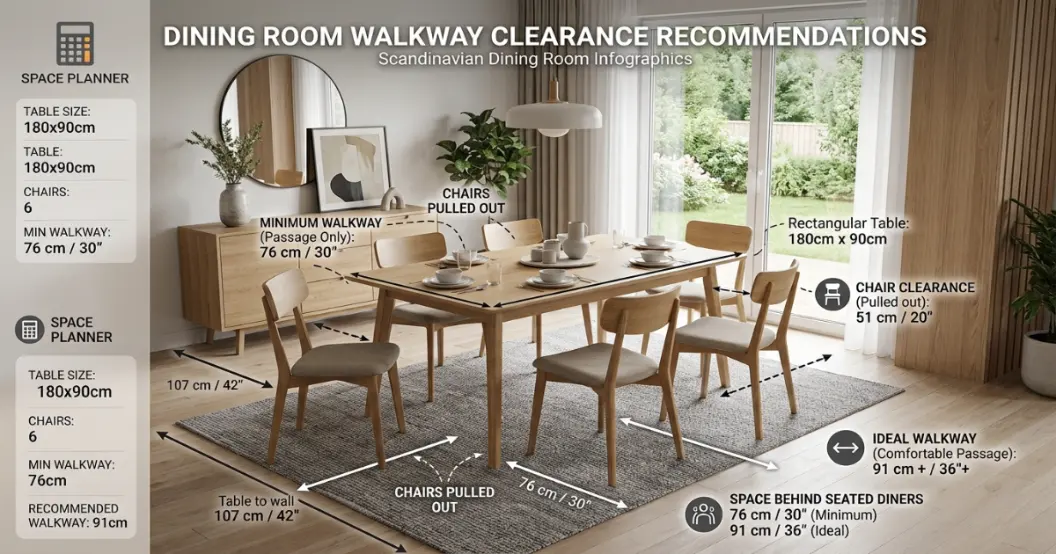
How Much Clearance Should You Allow?
As a general planning guide:
- Around 75 cm: tight but workable in very compact rooms.
- Around 90 cm: preferable where the room allows it.
- About 60–70 cm behind an occupied chair: useful additional planning allowance.
These are guides rather than rigid rules because furniture shape, chair depth and room layout vary. :contentReference[oaicite:3]{index=3}
A dining table does not truly fit if the table fits but the chairs and people do not.
Which Extendable Table Size Is Right for Your Family?
The strongest rule is simple: buy for your everyday household size, then extend for guests.
Do not permanently give up floor space for the maximum number of people who might visit twice a month.
This is exactly what extendable tables are designed to solve. :contentReference[oaicite:4]{index=4}
4→6 Seats
This is the most popular extendable configuration for the core apartment and family customer.
It is particularly suitable for:
- Couples.
- Families of four.
- Small apartments.
- Open-plan living/dining rooms.
Four people have a comfortable daily dining space, while two extra places are available when relatives or friends arrive.
6→8 Seats
This configuration works well for:
- Families of five or six.
- Homes that entertain regularly.
- Medium-sized dining rooms.
It provides the flexibility for larger weekend meals without requiring a permanent eight-person table.
8→10 Seats
This is a more specialised option for:
- Large families.
- Frequent entertainers.
- Larger dining rooms.
It delivers excellent hosting capacity but requires enough space in both its closed and fully extended positions.
Why Extendable Tables Suit Mauritian Family Life
Mauritian dining requirements are not necessarily consistent every day.
A household may consist of four people Monday to Saturday and suddenly need six, eight or more seats for:
- Sunday family lunch.
- Eid.
- Christmas.
- New Year.
- Weddings and family gatherings.
- Other festive occasions.
The important point is that these larger seating requirements occur periodically rather than every day. :contentReference[oaicite:5]{index=5}
Keeping an oversized fixed dining table in the room simply for those occasions means living with the larger footprint for the rest of the year.
An extendable table reverses that compromise.
Why Apartments Benefit the Most
Extendable tables are especially useful in Mauritian apartments where dining, kitchen and living zones frequently share the same open-plan area.
A smaller closed table:
- Improves circulation.
- Makes the room feel visually larger.
- Creates more flexibility around the sofa and TV area.
- Allows easier movement between kitchen and living zones.
When guests arrive, the table expands temporarily into the available floor area.
After the meal, it returns to its smaller daily footprint. :contentReference[oaicite:6]{index=6}
Round or Rectangular: Which Saves More Space?
Round Extendable Tables
Round tables work particularly well in very tight spaces because they have no sharp corners extending into the walking path.
This can make circulation feel easier in small rooms.
Round tables also create a more conversational dining arrangement because everyone faces more directly toward the centre.
Rectangular Extendable Tables
Rectangular tables remain more popular overall because they:
- Suit more dining room shapes.
- Work well for larger families.
- Extend efficiently to higher seating capacities.
- Can be positioned against a wall when space is limited.
For a very tight dining zone, round may save more circulation space.
For larger families and more flexible placement, rectangular is usually the more practical all-round choice. :contentReference[oaicite:7]{index=7}
Use Visual Weight to Make a Small Dining Area Feel Bigger
The table's physical dimensions are not the only thing that affects how large it feels.
For compact rooms, consider:
- Lighter finishes.
- Slimmer table legs.
- Open-base designs.
- Round tops where circulation is tight.
- Minimalist chair frames.
Heavy pedestal bases and very dark bulky tables can make a small dining room feel visually crowded even when the dimensions technically fit.
Can You Combine an Extendable Table With Bench Seating?
Yes.
A bench or banquette can be very effective in small dining areas because it reduces the number of individual chair footprints required.
A corner bench paired with an extendable table can make particularly efficient use of a compact room. :contentReference[oaicite:8]{index=8}
See How an Extendable Dining Table Works
A short demonstration is one of the easiest ways to understand the difference between centre-leaf, butterfly and other extension mechanisms.
The Extension Mechanism Matters More Than Most Buyers Realise
A dining table can have a beautiful tabletop and still become frustrating if the extension mechanism is poor.
On lower-quality tables, the first problems often appear in:
- Rails and runners.
- Tabletop alignment.
- Locking systems.
That is why mechanism quality matters as much as — and in daily use sometimes more than — the surface material. :contentReference[oaicite:9]{index=9}
Always Test the Table Before Buying
Do not simply look at the extended table in a showroom.
Operate it yourself.
Check:
- Does the table open smoothly?
- Does the extension lock securely?
- Do the two tabletop sections align correctly?
- Does the table remain stable when fully extended?
- Does it wobble?
- Can one person operate the mechanism comfortably?
One-person operation is particularly valuable because the table is much more likely to be used regularly if extending it is quick and simple.
Where Does the Extension Leaf Go?
This detail is easy to overlook.
Some tables store their leaves inside the table.
Others require the leaf to be removed completely and stored elsewhere.
If it does not self-store, ask yourself where it will realistically go.
Customers often end up storing separate leaves:
- Under a bed.
- In a utility room.
- Inside a wardrobe.
- Against a wall in a storage area.
In a small apartment, a self-storing leaf may therefore be worth prioritising even if the table costs slightly more. :contentReference[oaicite:10]{index=10}
Don't Forget the Spare Chairs
An extendable table may save floor space, but the extra chairs also need somewhere to live.
This is one of the most common practical oversights.
Good options include:
- Stackable spare chairs.
- Folding chairs.
- Chairs used in another room between gatherings.
- Bench seating.
Where matching chairs are available, buying the full number you expect to need at the same time can also prevent future differences in colour, upholstery or finish if the collection changes. :contentReference[oaicite:11]{index=11}
What Table Materials Work Best?
Common extendable dining table materials include:
- MDF or MDP with veneer or laminate finishes.
- Solid wood.
- Ceramic tops.
- Glass.
- Metal frames.
Best Value
MDF or MDP with a quality veneer finish generally offers a strong combination of price, appearance and everyday durability.
Premium Durability
Solid wood can provide excellent longevity, especially when combined with a well-engineered metal extension mechanism.
Easy Maintenance
Laminate and ceramic surfaces are especially practical in Mauritius because they are easy to wipe and handle humidity well.
Mauritius Humidity Matters
Humidity can affect both the tabletop and the mechanism.
Poorly protected timber-based components may move or swell over time, while lower-quality metal runners can develop corrosion.
For coastal homes, it is worth checking whether the extension hardware has appropriate rust or corrosion resistance. :contentReference[oaicite:12]{index=12}
Style: Keep the Table Timeless
Dining tables are usually long-term furniture purchases.
For that reason, timeless finishes often make more sense than heavily trend-driven designs.
Popular directions include:
- Oak.
- Walnut.
- White.
- Black.
- Marble-look or ceramic at the premium end.
Modern extendable mechanisms are generally integrated discreetly enough that the table does not need to look bulky simply because it expands. :contentReference[oaicite:13]{index=13}
Coordinate With the Rest of the Room
You do not need every dining-room item to come from the same collection.
But it helps if the table coordinates with:
- The sideboard.
- The flooring tone.
- Nearby living-room furniture in an open-plan layout.
This creates visual continuity even when the dining area is compact.
Is an Extendable Dining Table Worth the Extra Cost?
An extendable table generally costs more than an equivalent fixed table because of the additional mechanism and construction.
But price should be considered against what the table replaces.
One extendable table can remove the need for:
- An oversized fixed table used at half capacity most days.
- A second folding table stored somewhere else for guests.
- A dining room that permanently sacrifices circulation for occasional seating needs.
For households that use the extension regularly, the moderate premium can therefore offer strong long-term value. :contentReference[oaicite:14]{index=14}
Common Extendable Dining Table Buying Mistakes
Mistake #1: Not Measuring the Fully Extended Size
This is the most important mistake and the one most likely to create post-purchase frustration.
Measure both table lengths before buying.
Mistake #2: Ignoring Chair Clearance
Measure the room with chairs pulled out, not pushed neatly under the table.
Mistake #3: Buying Too Large “Just in Case”
Buy for everyday household size and use the extension for occasional guests.
That is the entire point of the design.
Mistake #4: Ignoring Mechanism Quality
A table that becomes difficult to extend is a table that eventually stays closed.
Mistake #5: Not Testing the Extension
Operate it yourself before purchasing whenever possible.
Mistake #6: Forgetting Spare Chair Storage
Plan the extra seats at the same time as the extra tabletop.
Mistake #7: Choosing Style Over Practicality
A beautiful table that blocks the room when extended is the wrong table for that space.
Mistake #8: Buying Only by Price
The extension mechanism is a moving system. Poor hardware can make a low initial price feel expensive later.
Your research ranks the failure to measure the fully extended footprint and chair clearance as the most significant source of buyer regret. :contentReference[oaicite:15]{index=15}
Which Table Should Different Households Choose?
| Household | Recommended Starting Point |
|---|---|
| Couple in apartment | Extendable 4→6 |
| Family of 4 | Extendable 4→6 |
| Family of 6 | Extendable 6→8 |
| Large family that hosts often | Extendable 6→8 or 8→10 |
| Small open-plan apartment | Extendable 4→6; round if circulation is especially tight |
| Elderly household | Fixed table for simplicity unless extra seating is regularly needed |
| Rental property | Fixed table for lower complexity and cost |
| Large dining room | Extendable 8→10 or large fixed table depending on hosting frequency |
These recommendations follow the household guidance in your research rather than assuming an extendable table is automatically the best solution for everyone. :contentReference[oaicite:16]{index=16}
Frequently Asked Questions
Are extendable dining tables good for small spaces?
Yes. Their main advantage is that they remain compact during everyday use and only occupy the larger footprint when extra seating is needed.
How much space do I need around an extendable dining table?
Around 75 cm may work in a tight room, while approximately 90 cm is preferable where space allows. Also account for the additional space required behind occupied chairs.
Are extendable dining tables durable?
They can be. Durability depends heavily on the quality of the extension rails, locking mechanism, table construction and how frequently the system is used.
Which is better: fixed or extendable dining table?
A fixed table is simpler and may suit a large room where seating needs rarely change. An extendable table is more flexible for households where guest numbers vary.
What size extendable table is best for a family of 4?
A 4→6 extendable table is usually a strong starting point because it serves the household comfortably every day and adds two guest places when needed.
How many people can an extendable dining table seat?
Common configurations include 4→6, 6→8 and 8→10 seats, depending on the table design.
Are round extendable tables good for small rooms?
Yes. Round tables remove sharp corners from the walking path and can make circulation easier in very compact dining areas.
Do extendable dining tables wobble?
A quality table should remain stable when extended. Wobble can indicate weak construction, poor alignment or a low-quality extension mechanism, which is why in-store testing is important.
Should I buy extra chairs with an extendable dining table?
If matching chairs are available and you know you will need them, buying the required number together can reduce the risk of colour or finish differences later.
Are extendable tables worth the extra cost?
For households that need extra seating occasionally, they can offer excellent value because one table replaces the need for an oversized permanent table or a separate guest table.
What dining table shape saves the most space?
Round tables often improve circulation in very tight rooms, while rectangular tables are generally easier to position against walls and accommodate larger families.
Are extendable dining tables suitable for apartments in Mauritius?
Yes. Apartments and small open-plan homes are among the strongest use cases because the smaller everyday footprint preserves valuable floor space.
How do I measure my dining room before buying an extendable table?
Measure the room, then mark both the closed and fully extended table dimensions. Include the depth of pulled-out chairs and enough walking space around occupied seats.
What should I check in the extension mechanism?
Check smooth opening, secure locking, correct tabletop alignment, stability and whether one person can operate it comfortably.
Which dining table material is best for Mauritius?
Laminate and ceramic surfaces are especially easy to maintain in humid conditions, while quality MDF/MDP veneer tables can provide good value. Solid wood can offer excellent durability when properly constructed and maintained.
Can an extendable dining table be used every day?
Yes. Most owners use the table in its closed position as their everyday dining table and extend it only when additional seating is required. :contentReference[oaicite:17]{index=17}
How do I clean and maintain an extendable table mechanism?
Keep the runners clean and free from food debris, avoid forcing the extension if it becomes stiff, and check the manufacturer's care instructions before applying any lubricant or cleaning product.
Choosing an Extendable Table at TFP
To keep this guide useful as individual collections change, the most relevant categories are:
- Extendable dining tables.
- Dining sets.
- Dining chairs.
- Sideboards.
- Dining benches.
Testing in-store is especially valuable with extendable tables because the mechanism is part of the product experience, not simply a specification on a label.
Open the table.
Close it.
Sit at it.
Check the leg position.
Make sure the table feels comfortable both when compact and fully extended.
Keeping product references category-based also helps the article remain evergreen as individual dining collections change. :contentReference[oaicite:18]{index=18}
TFP's Final Verdict: Buy for Every Day — Extend for the Days That Matter
A dining table should not make your home less comfortable simply because guests might visit occasionally.
If four people live in the home, there is little benefit in permanently sacrificing valuable dining-room or apartment floor space for a large eight-seat table that spends most of the year half empty.
An extendable table lets the room adapt instead.
Keep it compact for:
- Breakfast.
- Weekday meals.
- Homework.
- Everyday family dining.
Then extend it for:
- Sunday lunches.
- Festive gatherings.
- Friends.
- Relatives.
- The occasions when the extra places genuinely matter.
Before buying, remember three things:
- Measure the fully extended table, not only the closed one.
- Allow room for chairs and people, not only the tabletop.
- Test the extension mechanism yourself.
Get those three decisions right and an extendable table can give a small dining area far more flexibility without permanently occupying more space.
The best dining table is not the biggest one you can fit — it is the one that adapts to how your family actually lives, every day and on the days that matter most.
TFP – Helping Mauritian families make better use of their dining space without compromising the moments when everyone comes together.
How Extendable Dining Tables Help You Save Space
A practical Mauritius guide to choosing an extendable dining table that stays compact every day and gives you extra seating when family and guests arrive
A large dining table sounds useful until you realise that most days, half of it is empty.
For many Mauritian families, the dining table only needs extra seating occasionally — when relatives visit, during Sunday lunches, festive periods, weddings, Christmas, New Year or Eid gatherings.
The rest of the time, that oversized fixed table still occupies the same amount of floor space.
That is exactly where an extendable dining table becomes useful.
It gives you a compact everyday table for your normal household size, then expands when additional seating is genuinely needed. For apartment owners, small-home families and newly married couples, this can make the difference between a dining area that feels permanently crowded and one that feels comfortable most of the year. :contentReference[oaicite:0]{index=0}
The real advantage of an extendable table is not simply that it gets bigger — it is that it does not have to stay big.
What Is an Extendable Dining Table?
An extendable dining table is a table that increases in length, and usually seating capacity, by adding, unfolding or revealing an additional section called a leaf.
Instead of buying one compact table for everyday use and another table for guests, the same table performs both jobs. :contentReference[oaicite:1]{index=1}
Common Extension Systems
Different tables extend in different ways.
Centre Leaf
The tabletop separates in the middle and an additional section is inserted between the two halves.
Many centre-leaf systems store the leaf inside the table itself, which is especially useful in apartments where separate leaf storage would otherwise become another problem.
Butterfly Leaf
A butterfly leaf folds inside the table and unfolds when the table is extended.
This is one of the most convenient systems because the additional section stays attached to the table and does not require separate storage.
Drop-Leaf Table
One or both sides of the tabletop fold down when not required.
This is particularly useful in very compact spaces where the table may be positioned against a wall most of the time.
Pull-Out Extension
The tabletop slides or pulls outward to reveal an additional section.
The exact mechanism varies by design, which is why testing the table before buying is important.
Extendable vs Fixed vs Folding vs Drop-Leaf
| Table Type | Main Advantage | Best For |
|---|---|---|
| Extendable | Compact daily size with larger guest capacity | Families, apartments, regular entertaining |
| Fixed | Simple, stable and no mechanism to maintain | Homes with enough permanent dining space |
| Folding | Can be stored away completely | Very occasional use |
| Drop-leaf | Extremely compact when folded | Studios and very small dining areas |
The Biggest Space-Saving Benefit: You Only Use the Large Footprint When You Need It
This is the most important reason to consider an extendable table.
A typical household may have four people but occasionally need seating for six.
With a fixed six-seater, the room permanently gives up enough space for six places even though two seats may remain empty most days.
With a 4→6 extendable table, the room can stay arranged around the smaller four-seat footprint during normal daily use.
Your research estimates that keeping the table closed can free roughly 40–60 cm of useful walking space in some small dining rooms, which can be the difference between comfortable circulation and a room that feels cramped. :contentReference[oaicite:2]{index=2}
Always Measure the Closed AND Extended Table
This is where many buyers get caught.
They measure the closed table, confirm that it fits, and stop there.
Then they extend it for the first family gathering and discover:
- The table nearly touches the sofa.
- A chair cannot be pulled out properly.
- The walkway disappears.
- The sideboard becomes inaccessible.
- Guests cannot move comfortably around the room.
The table itself is only one part of the footprint.
You also need space for the chairs and the people sitting in them.
How Much Clearance Should You Allow?
As a general planning guide:
- Around 75 cm: tight but workable in very compact rooms.
- Around 90 cm: preferable where the room allows it.
- About 60–70 cm behind an occupied chair: useful additional planning allowance.
These are guides rather than rigid rules because furniture shape, chair depth and room layout vary. :contentReference[oaicite:3]{index=3}
A dining table does not truly fit if the table fits but the chairs and people do not.
Which Extendable Table Size Is Right for Your Family?
The strongest rule is simple: buy for your everyday household size, then extend for guests.
Do not permanently give up floor space for the maximum number of people who might visit twice a month.
This is exactly what extendable tables are designed to solve. :contentReference[oaicite:4]{index=4}
4→6 Seats
This is the most popular extendable configuration for the core apartment and family customer.
It is particularly suitable for:
- Couples.
- Families of four.
- Small apartments.
- Open-plan living/dining rooms.
Four people have a comfortable daily dining space, while two extra places are available when relatives or friends arrive.
6→8 Seats
This configuration works well for:
- Families of five or six.
- Homes that entertain regularly.
- Medium-sized dining rooms.
It provides the flexibility for larger weekend meals without requiring a permanent eight-person table.
8→10 Seats
This is a more specialised option for:
- Large families.
- Frequent entertainers.
- Larger dining rooms.
It delivers excellent hosting capacity but requires enough space in both its closed and fully extended positions.
Why Extendable Tables Suit Mauritian Family Life
Mauritian dining requirements are not necessarily consistent every day.
A household may consist of four people Monday to Saturday and suddenly need six, eight or more seats for:
- Sunday family lunch.
- Eid.
- Christmas.
- New Year.
- Weddings and family gatherings.
- Other festive occasions.
The important point is that these larger seating requirements occur periodically rather than every day. :contentReference[oaicite:5]{index=5}
Keeping an oversized fixed dining table in the room simply for those occasions means living with the larger footprint for the rest of the year.
An extendable table reverses that compromise.
Why Apartments Benefit the Most
Extendable tables are especially useful in Mauritian apartments where dining, kitchen and living zones frequently share the same open-plan area.
A smaller closed table:
- Improves circulation.
- Makes the room feel visually larger.
- Creates more flexibility around the sofa and TV area.
- Allows easier movement between kitchen and living zones.
When guests arrive, the table expands temporarily into the available floor area.
After the meal, it returns to its smaller daily footprint. :contentReference[oaicite:6]{index=6}
Round or Rectangular: Which Saves More Space?
Round Extendable Tables
Round tables work particularly well in very tight spaces because they have no sharp corners extending into the walking path.
This can make circulation feel easier in small rooms.
Round tables also create a more conversational dining arrangement because everyone faces more directly toward the centre.
Rectangular Extendable Tables
Rectangular tables remain more popular overall because they:
- Suit more dining room shapes.
- Work well for larger families.
- Extend efficiently to higher seating capacities.
- Can be positioned against a wall when space is limited.
For a very tight dining zone, round may save more circulation space.
For larger families and more flexible placement, rectangular is usually the more practical all-round choice. :contentReference[oaicite:7]{index=7}
Use Visual Weight to Make a Small Dining Area Feel Bigger
The table's physical dimensions are not the only thing that affects how large it feels.
For compact rooms, consider:
- Lighter finishes.
- Slimmer table legs.
- Open-base designs.
- Round tops where circulation is tight.
- Minimalist chair frames.
Heavy pedestal bases and very dark bulky tables can make a small dining room feel visually crowded even when the dimensions technically fit.
Can You Combine an Extendable Table With Bench Seating?
Yes.
A bench or banquette can be very effective in small dining areas because it reduces the number of individual chair footprints required.
A corner bench paired with an extendable table can make particularly efficient use of a compact room. :contentReference[oaicite:8]{index=8}
See How an Extendable Dining Table Works
A short demonstration is one of the easiest ways to understand the difference between centre-leaf, butterfly and other extension mechanisms.
The Extension Mechanism Matters More Than Most Buyers Realise
A dining table can have a beautiful tabletop and still become frustrating if the extension mechanism is poor.
On lower-quality tables, the first problems often appear in:
- Rails and runners.
- Tabletop alignment.
- Locking systems.
That is why mechanism quality matters as much as — and in daily use sometimes more than — the surface material. :contentReference[oaicite:9]{index=9}
Always Test the Table Before Buying
Do not simply look at the extended table in a showroom.
Operate it yourself.
Check:
- Does the table open smoothly?
- Does the extension lock securely?
- Do the two tabletop sections align correctly?
- Does the table remain stable when fully extended?
- Does it wobble?
- Can one person operate the mechanism comfortably?
One-person operation is particularly valuable because the table is much more likely to be used regularly if extending it is quick and simple.
Where Does the Extension Leaf Go?
This detail is easy to overlook.
Some tables store their leaves inside the table.
Others require the leaf to be removed completely and stored elsewhere.
If it does not self-store, ask yourself where it will realistically go.
Customers often end up storing separate leaves:
- Under a bed.
- In a utility room.
- Inside a wardrobe.
- Against a wall in a storage area.
In a small apartment, a self-storing leaf may therefore be worth prioritising even if the table costs slightly more. :contentReference[oaicite:10]{index=10}
Don't Forget the Spare Chairs
An extendable table may save floor space, but the extra chairs also need somewhere to live.
This is one of the most common practical oversights.
Good options include:
- Stackable spare chairs.
- Folding chairs.
- Chairs used in another room between gatherings.
- Bench seating.
Where matching chairs are available, buying the full number you expect to need at the same time can also prevent future differences in colour, upholstery or finish if the collection changes. :contentReference[oaicite:11]{index=11}
What Table Materials Work Best?
Common extendable dining table materials include:
- MDF or MDP with veneer or laminate finishes.
- Solid wood.
- Ceramic tops.
- Glass.
- Metal frames.
Best Value
MDF or MDP with a quality veneer finish generally offers a strong combination of price, appearance and everyday durability.
Premium Durability
Solid wood can provide excellent longevity, especially when combined with a well-engineered metal extension mechanism.
Easy Maintenance
Laminate and ceramic surfaces are especially practical in Mauritius because they are easy to wipe and handle humidity well.
Mauritius Humidity Matters
Humidity can affect both the tabletop and the mechanism.
Poorly protected timber-based components may move or swell over time, while lower-quality metal runners can develop corrosion.
For coastal homes, it is worth checking whether the extension hardware has appropriate rust or corrosion resistance. :contentReference[oaicite:12]{index=12}
Style: Keep the Table Timeless
Dining tables are usually long-term furniture purchases.
For that reason, timeless finishes often make more sense than heavily trend-driven designs.
Popular directions include:
- Oak.
- Walnut.
- White.
- Black.
- Marble-look or ceramic at the premium end.
Modern extendable mechanisms are generally integrated discreetly enough that the table does not need to look bulky simply because it expands. :contentReference[oaicite:13]{index=13}
Coordinate With the Rest of the Room
You do not need every dining-room item to come from the same collection.
But it helps if the table coordinates with:
- The sideboard.
- The flooring tone.
- Nearby living-room furniture in an open-plan layout.
This creates visual continuity even when the dining area is compact.
Is an Extendable Dining Table Worth the Extra Cost?
An extendable table generally costs more than an equivalent fixed table because of the additional mechanism and construction.
But price should be considered against what the table replaces.
One extendable table can remove the need for:
- An oversized fixed table used at half capacity most days.
- A second folding table stored somewhere else for guests.
- A dining room that permanently sacrifices circulation for occasional seating needs.
For households that use the extension regularly, the moderate premium can therefore offer strong long-term value. :contentReference[oaicite:14]{index=14}
Common Extendable Dining Table Buying Mistakes
Mistake #1: Not Measuring the Fully Extended Size
This is the most important mistake and the one most likely to create post-purchase frustration.
Measure both table lengths before buying.
Mistake #2: Ignoring Chair Clearance
Measure the room with chairs pulled out, not pushed neatly under the table.
Mistake #3: Buying Too Large “Just in Case”
Buy for everyday household size and use the extension for occasional guests.
That is the entire point of the design.
Mistake #4: Ignoring Mechanism Quality
A table that becomes difficult to extend is a table that eventually stays closed.
Mistake #5: Not Testing the Extension
Operate it yourself before purchasing whenever possible.
Mistake #6: Forgetting Spare Chair Storage
Plan the extra seats at the same time as the extra tabletop.
Mistake #7: Choosing Style Over Practicality
A beautiful table that blocks the room when extended is the wrong table for that space.
Mistake #8: Buying Only by Price
The extension mechanism is a moving system. Poor hardware can make a low initial price feel expensive later.
Your research ranks the failure to measure the fully extended footprint and chair clearance as the most significant source of buyer regret. :contentReference[oaicite:15]{index=15}
Which Table Should Different Households Choose?
| Household | Recommended Starting Point |
|---|---|
| Couple in apartment | Extendable 4→6 |
| Family of 4 | Extendable 4→6 |
| Family of 6 | Extendable 6→8 |
| Large family that hosts often | Extendable 6→8 or 8→10 |
| Small open-plan apartment | Extendable 4→6; round if circulation is especially tight |
| Elderly household | Fixed table for simplicity unless extra seating is regularly needed |
| Rental property | Fixed table for lower complexity and cost |
| Large dining room | Extendable 8→10 or large fixed table depending on hosting frequency |
These recommendations follow the household guidance in your research rather than assuming an extendable table is automatically the best solution for everyone. :contentReference[oaicite:16]{index=16}
Frequently Asked Questions
Are extendable dining tables good for small spaces?
Yes. Their main advantage is that they remain compact during everyday use and only occupy the larger footprint when extra seating is needed.
How much space do I need around an extendable dining table?
Around 75 cm may work in a tight room, while approximately 90 cm is preferable where space allows. Also account for the additional space required behind occupied chairs.
Are extendable dining tables durable?
They can be. Durability depends heavily on the quality of the extension rails, locking mechanism, table construction and how frequently the system is used.
Which is better: fixed or extendable dining table?
A fixed table is simpler and may suit a large room where seating needs rarely change. An extendable table is more flexible for households where guest numbers vary.
What size extendable table is best for a family of 4?
A 4→6 extendable table is usually a strong starting point because it serves the household comfortably every day and adds two guest places when needed.
How many people can an extendable dining table seat?
Common configurations include 4→6, 6→8 and 8→10 seats, depending on the table design.
Are round extendable tables good for small rooms?
Yes. Round tables remove sharp corners from the walking path and can make circulation easier in very compact dining areas.
Do extendable dining tables wobble?
A quality table should remain stable when extended. Wobble can indicate weak construction, poor alignment or a low-quality extension mechanism, which is why in-store testing is important.
Should I buy extra chairs with an extendable dining table?
If matching chairs are available and you know you will need them, buying the required number together can reduce the risk of colour or finish differences later.
Are extendable tables worth the extra cost?
For households that need extra seating occasionally, they can offer excellent value because one table replaces the need for an oversized permanent table or a separate guest table.
What dining table shape saves the most space?
Round tables often improve circulation in very tight rooms, while rectangular tables are generally easier to position against walls and accommodate larger families.
Are extendable dining tables suitable for apartments in Mauritius?
Yes. Apartments and small open-plan homes are among the strongest use cases because the smaller everyday footprint preserves valuable floor space.
How do I measure my dining room before buying an extendable table?
Measure the room, then mark both the closed and fully extended table dimensions. Include the depth of pulled-out chairs and enough walking space around occupied seats.
What should I check in the extension mechanism?
Check smooth opening, secure locking, correct tabletop alignment, stability and whether one person can operate it comfortably.
Which dining table material is best for Mauritius?
Laminate and ceramic surfaces are especially easy to maintain in humid conditions, while quality MDF/MDP veneer tables can provide good value. Solid wood can offer excellent durability when properly constructed and maintained.
Can an extendable dining table be used every day?
Yes. Most owners use the table in its closed position as their everyday dining table and extend it only when additional seating is required. :contentReference[oaicite:17]{index=17}
How do I clean and maintain an extendable table mechanism?
Keep the runners clean and free from food debris, avoid forcing the extension if it becomes stiff, and check the manufacturer's care instructions before applying any lubricant or cleaning product.
Choosing an Extendable Table at TFP
To keep this guide useful as individual collections change, the most relevant categories are:
- Extendable dining tables.
- Dining sets.
- Dining chairs.
- Sideboards.
- Dining benches.
Testing in-store is especially valuable with extendable tables because the mechanism is part of the product experience, not simply a specification on a label.
Open the table.
Close it.
Sit at it.
Check the leg position.
Make sure the table feels comfortable both when compact and fully extended.
Keeping product references category-based also helps the article remain evergreen as individual dining collections change. :contentReference[oaicite:18]{index=18}
TFP's Final Verdict: Buy for Every Day — Extend for the Days That Matter
A dining table should not make your home less comfortable simply because guests might visit occasionally.
If four people live in the home, there is little benefit in permanently sacrificing valuable dining-room or apartment floor space for a large eight-seat table that spends most of the year half empty.
An extendable table lets the room adapt instead.
Keep it compact for:
- Breakfast.
- Weekday meals.
- Homework.
- Everyday family dining.
Then extend it for:
- Sunday lunches.
- Festive gatherings.
- Friends.
- Relatives.
- The occasions when the extra places genuinely matter.
Before buying, remember three things:
- Measure the fully extended table, not only the closed one.
- Allow room for chairs and people, not only the tabletop.
- Test the extension mechanism yourself.
Get those three decisions right and an extendable table can give a small dining area far more flexibility without permanently occupying more space.
The best dining table is not the biggest one you can fit — it is the one that adapts to how your family actually lives, every day and on the days that matter most.
TFP – Helping Mauritian families make better use of their dining space without compromising the moments when everyone comes together.