Foam vs Pocket Spring Mattress: Which Is Right for You in Mauritius?
An honest buying guide to mattress types, comfort, climate and value, written for warm Mauritian bedrooms.
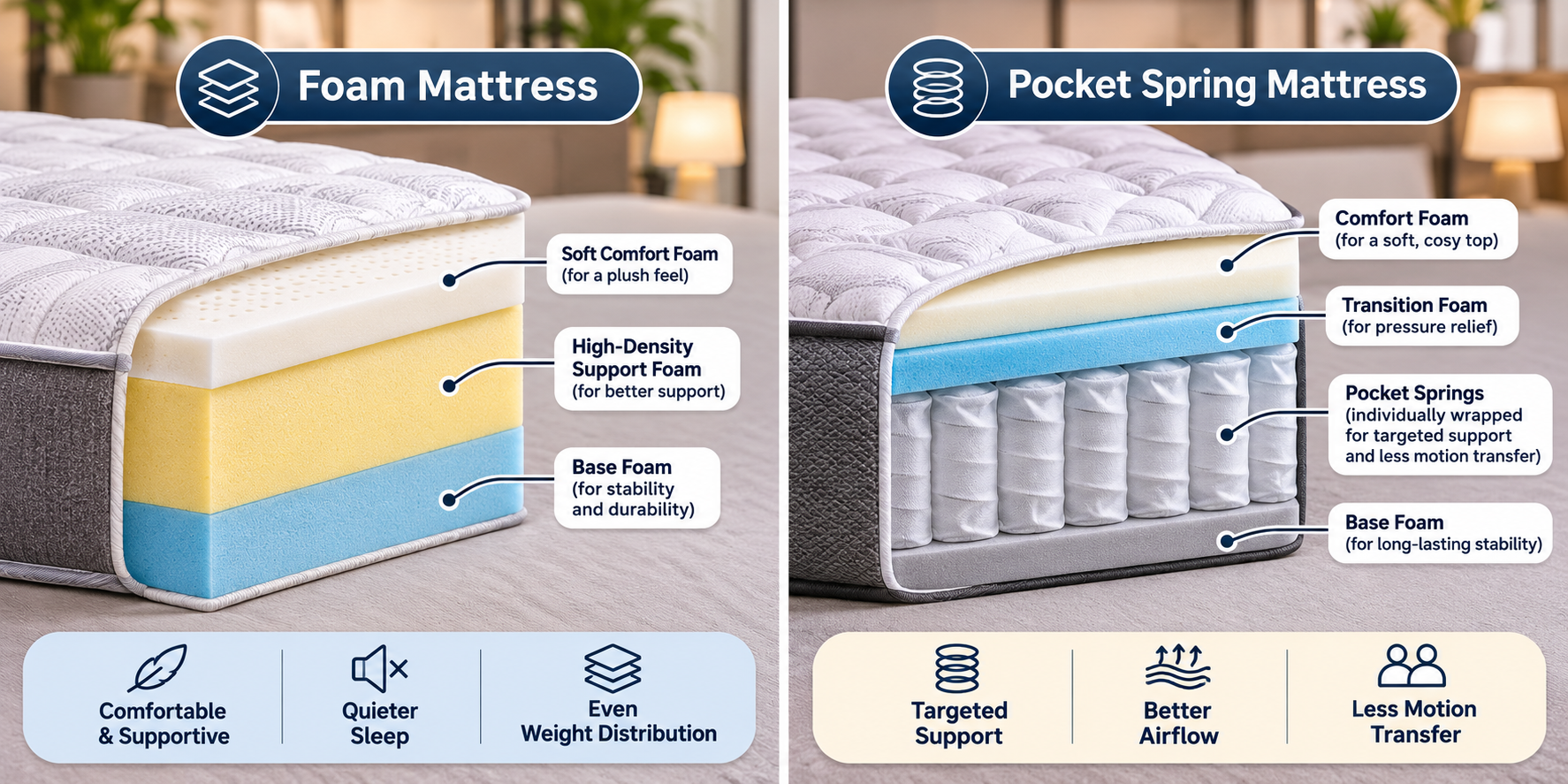
Two different ways to build a mattress. The right one depends on you.
Whether you're a newly married couple setting up your first bedroom or a family replacing a mattress that's past its best, choosing between foam and pocket spring can feel confusing. Many customers arrive at TFP believing every spring mattress is the same, or that every foam mattress is memory foam. Neither is true.
Pocket spring mattresses are currently the more popular choice among TFP customers, but interest in foam, especially memory foam and high-density foam, has grown a lot in recent years. This guide explains how each type works, how they compare in Mauritius's heat and humidity, and how to test a mattress properly so you choose with confidence.
What Is a Foam Mattress?
A foam mattress uses layers of foam to provide cushioning and support, without a metal spring core. There are several types of foam, and they behave very differently:
- Conventional polyurethane foam: the most basic and affordable foam
- High-density polyurethane foam: the most common foam in TFP's range, popular for durability at an accessible price
- High-resilience foam: springs back quickly after pressure, giving a more responsive feel
- Memory foam: reacts to body heat and pressure, slowly moulding around your body
Many foam mattresses combine different layers to achieve a particular feel. Foam mattresses come in soft, medium and firm options, so "foam" doesn't automatically mean soft. They're also generally lighter than pocket spring mattresses of the same size.
What Is a Pocket Spring Mattress?
A pocket spring mattress contains individual metal springs, each sealed in its own fabric pocket. Because each spring moves on its own, it responds to pressure more independently than traditional connected spring systems.
Not all spring mattresses are pocket spring mattresses. This is one of the most important differences to understand:
- Pocket springs: individually wrapped and moving independently
- Bonnell springs: hourglass-shaped springs joined together by wire
- Continuous coil: one long wire shaped into many springs
- Offset springs: another type of connected spring system
TFP's pocket spring mattresses include foam comfort layers above the springs. The springs provide the support, while the foam layers give the cushioning and surface feel. They're available across several price ranges and are generally more expensive than basic foam mattresses.
What About Hybrid Mattresses?
A hybrid mattress combines a spring support core with substantial foam or other comfort layers to balance support, cushioning and responsiveness. Since most pocket spring mattresses already have some foam, the term "hybrid" isn't used consistently. It usually describes mattresses with a thicker foam comfort layer, often 5 cm or more, rather than a thin padding layer.
TFP's Royal Lux range includes hybrid options, so confirm specific model details at tfp.mu or in-store. Hybrids sit in a higher price category and can suit couples with different comfort preferences, but they aren't automatically better than other types.
The Fundamental Difference
- Foam: support and pressure relief come from the properties and arrangement of the foam layers.
- Pocket spring: support comes mainly from individually pocketed springs, with comfort shaped by the layers above them.
Either type can be made to feel soft, medium or firm. Pocket spring isn't automatically firmer, and foam isn't automatically more comfortable. Comfort depends on the complete mattress design, not one material.
Foam vs Pocket Spring vs Hybrid at a Glance
| Factor | Foam | Pocket Spring | Hybrid |
|---|---|---|---|
| Support type | Foam layer properties | Individual spring response | Springs + substantial foam |
| Temperature | Can retain heat, depending on build | Generally more airflow | Varies |
| Motion isolation | Generally very good | Good (better than connected springs) | Good |
| Responsiveness | Varies (memory foam is slower) | Generally more responsive | Good |
| Edge support | Depends on construction | Can be reinforced | Can be reinforced |
| Noise | Silent | Can squeak over time | Varies |
| Price | Wide range, accessible entry point | Generally mid to higher | Generally higher |
| Best for | Quiet sleep, motion sensitivity, pressure relief | Warm bedrooms, responsive feel, couples | Couples, balanced preferences |
| Durability | Depends on quality | Depends on quality | Depends on quality |
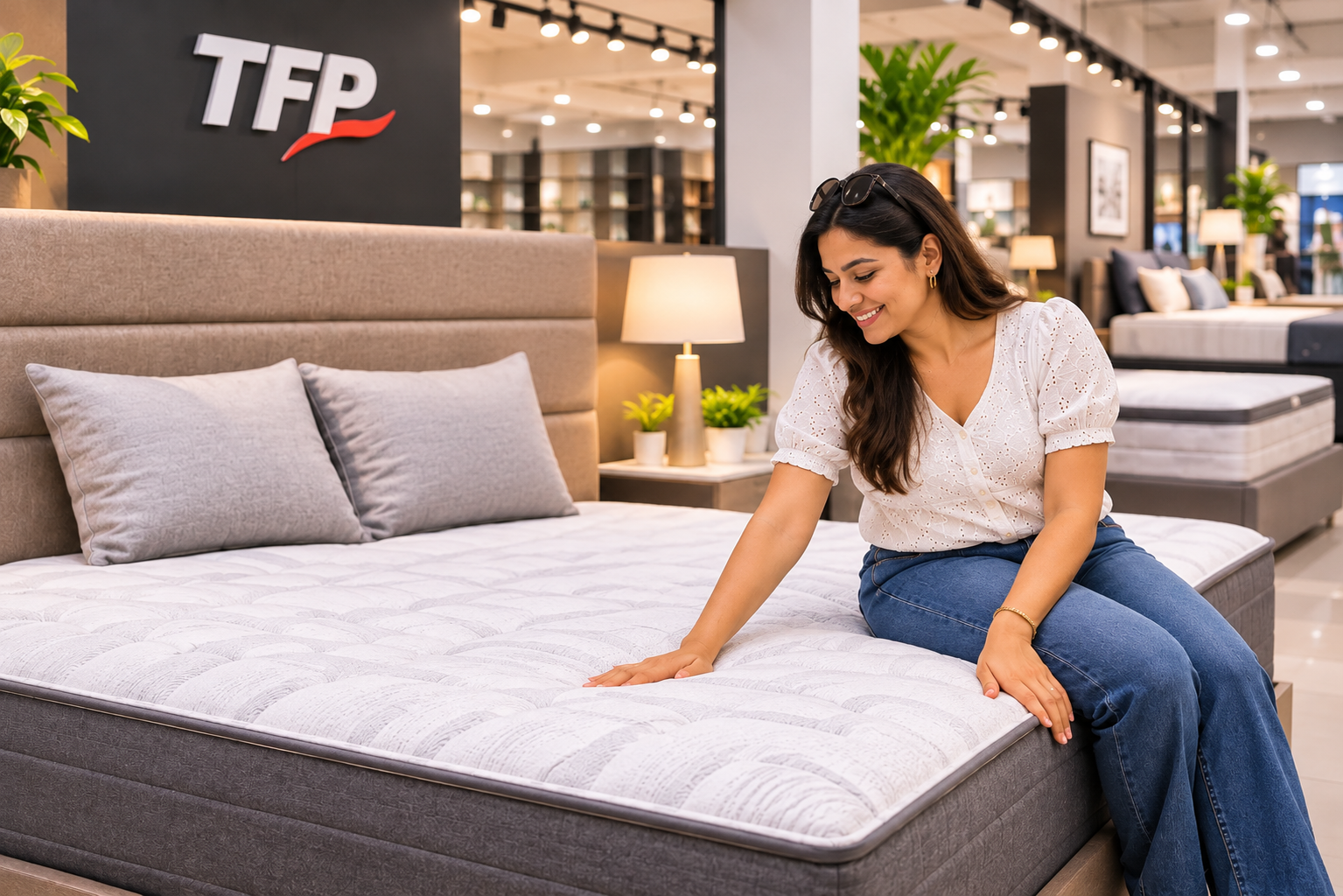
The best way to choose: lie down, take your time, and test together.
Sleeping Cool in Mauritius's Heat
Sleeping temperature is one of the most common concerns we hear, especially during the warm season from October to April and in bedrooms without air-conditioning.
Pocket Spring and Airflow
Pocket spring mattresses are generally seen as sleeping cooler than dense all-foam mattresses. The open space inside the spring core lets more air move through the mattress. However, the comfort layers, cover fabric and overall design also affect temperature, so not every pocket spring mattress sleeps cooler than every foam mattress.
Foam and Heat
Some foam mattresses hold more body heat, especially dense memory foam. Open-cell and perforated foams allow more airflow, so ask about breathable options. Gel-infused foam can feel cool at first, but that effect fades once the gel warms to body temperature. It isn't a guarantee of a cooler night.
Your Bedroom Matters Too
- Mattress cover: a breathable knitted cover lets more air through than a thick quilted one. Selected TFP models have knitted covers, and some have removable covers.
- Bedding: cotton sheets and lightweight bedding help in warm weather.
- Fans and air-conditioning: a mattress that feels hot in a closed room may feel perfectly comfortable with a ceiling fan or AC.
- Ventilation: open windows and air movement make a real difference.
Humidity, Moisture and Mould
Humidity is a separate issue from heat. Moisture can build up under a mattress, especially in poorly ventilated rooms, against damp walls or in older homes with roof or wall leaks. Both foam and pocket spring mattresses can develop mould if moisture persists. No mattress type is mould-proof.
- Never place a mattress directly on the floor. Air can't circulate underneath, and moisture can collect.
- Use a suitable bed base that lets air flow underneath, and follow the manufacturer's bed-base requirements. Solid platforms may need ventilation openings.
- Choose the right protector. Waterproof protectors stop spills but can trap heat and moisture; breathable protectors allow more airflow but offer less liquid protection.
- Keep mattresses away from damp walls and ventilate the bedroom regularly where you can.
- Fix the cause first. If an old mattress has mould, check for roof leaks, condensation or damp before buying a new one, or the problem may return.
Firmness: Is Firm Really Best for Your Back?
Many people believe a firm mattress is automatically better for the back. It isn't that simple.
- Firmness is how soft or hard the surface feels.
- Support is how well the mattress keeps your spine in a comfortable, natural position.
A softer mattress can be supportive for some people, while a very firm mattress can create uncomfortable pressure at the shoulders and hips, especially for side sleepers. Firmness labels also aren't standardised. One brand's "medium-firm" can feel quite different from another's, which is why testing in person matters.
Your Sleeping Position
Not sure how you sleep? Think about the position you wake up in most often. Then test mattresses in that position.
| Sleeping position | What to prioritise |
|---|---|
| Side | Comfort at the shoulders and hips |
| Back | Balanced support and cushioning |
| Stomach | Avoiding too much sinking at the hips and midsection |
| Combination | Easy movement between positions |
These are general tendencies, not medical rules. Body shape, weight and personal preference all change what feels right.
Body Weight and Support
Heavier sleepers often prefer stronger support that keeps the surface even. Well-designed high-density foam and pocket spring systems can both do this. For springs, wire gauge, zoning and comfort layers all make a difference. Check manufacturer weight guidance where it's available.
Lighter sleepers often find the same mattress feels firmer, because they sink into it less. That's why couples with different body weights should always test a mattress together.
Foam or Pocket Spring: How to Choose the Right Mattress for Mauritius
Pressure Relief: Sleeping "In" vs Sleeping "On"
Memory foam is known for moulding around the body and spreading pressure. Some people love this; others dislike the sinking feeling and feel "trapped". Pocket spring mattresses can also relieve pressure well through their comfort layers.
- Sleeping "in" a mattress: deep, contouring foam that hugs your body
- Sleeping "on" a mattress: a more responsive surface that holds you up
Not all foam sinks. High-resilience and some open-cell foams are much more responsive than dense memory foam. Also, soft doesn't always mean good pressure relief: a firm mattress can relieve pressure well, while a soft one may not if its layers compress unevenly.
Motion Isolation for Couples
Feeling your partner move or get out of bed is a common sleep disturbance.
- Foam generally absorbs movement well, keeping it in one spot.
- Pocket springs can also isolate movement well, because each spring responds on its own.
- Traditional connected springs tend to pass more movement across the bed.
Foam doesn't always beat pocket springs here. A well-designed pocket spring mattress can perform just as well.
Edge Support
Many people sit on the edge of the bed to dress, and couples often sleep near the edges. Weak edges make the outer part of the mattress feel unstable, reducing the usable sleeping area. This matters especially on smaller doubles shared by two adults.
Pocket spring mattresses can have reinforced perimeter springs or foam edges, and some foam mattresses use firmer foam around the edges. Not every pocket spring mattress has better edge support. Selected TFP models have reinforced edges. Sit on the edge in the showroom and check that it feels stable.
Ease of Movement
Some memory foam responds slowly when you move, which can feel like resistance when changing position. Pocket spring mattresses generally feel more responsive and "buoyant", and high-resilience foam can feel responsive too. If you change position often during the night, this matters. When testing, roll from your side to your back and notice how easy it feels.
What Makes a Quality Mattress?
Foam Quality
- Density (kg/m³): higher density generally means more durable foam, but not necessarily firmer.
- Resilience: how quickly foam returns to shape. High-resilience and high-density describe different things.
- Terms like "premium foam" have no standard meaning, so ask about the actual foam specification. Density information is available for selected TFP models.
Pocket Spring Quality
- Wire gauge: thicker wire generally means more durable springs
- Spring count: more springs can give finer support, but more isn't automatically better
- Spring height and arrangement
- Zoning: different spring tensions for the shoulders, lower back and hips (ask which TFP models offer this)
- Edge reinforcement, including foam encasement around the perimeter
- Comfort-layer quality: this shapes much of how the mattress feels
Always look at the full specification, not just one headline number.
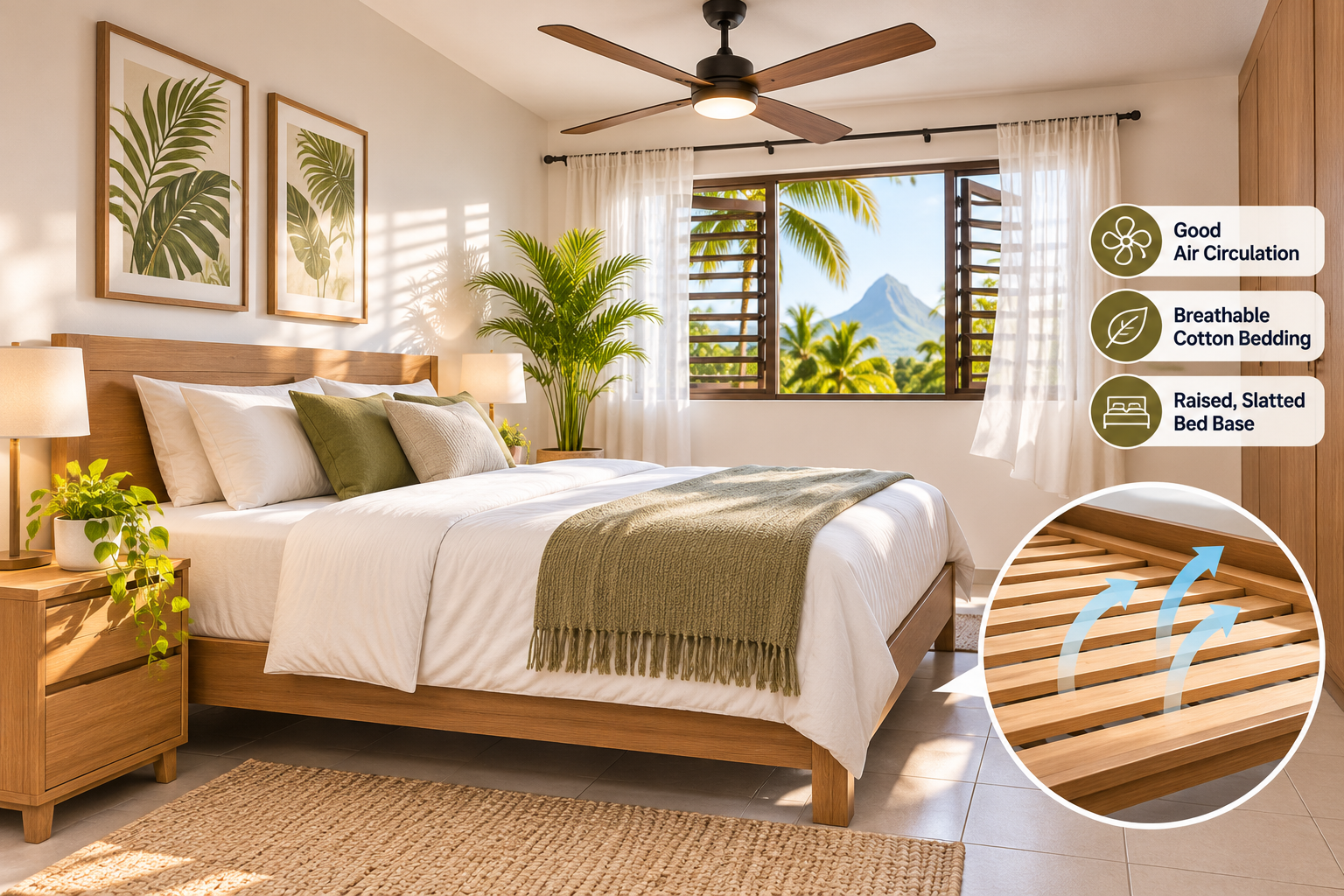
Airflow under and around the mattress keeps it fresh and comfortable.
Durability and Lifespan
Many people assume pocket spring mattresses always last longer than foam. That isn't reliably true. A high-quality foam mattress can outlast a poor pocket spring mattress, and the other way round. Both types can sag: foam through wear, and pocket springs through spring fatigue or comfort-layer wear.
Lifespan depends on material quality, body weight, how the mattress is used, ventilation, the bed base and maintenance.
Wondering if it's time for a new one? Read How to Know When It's Time to Replace Your Mattress in Mauritius.
Caring for Your Mattress
- Rotate as instructed. Follow your model's care instructions, as rotation intervals vary.
- Don't flip a one-sided mattress. Many mattresses are built to be used one way up only. Flipping can damage them and affect comfort.
- Use a mattress protector.
- Vacuum the surface according to the care instructions.
- Avoid soaking or steam cleaning unless the manufacturer allows it. Too much moisture can damage foam and internal parts.
- Keep the bed base clean and dry.
- Check for sagging: lay a straight edge, like a long ruler or spirit level, across the mattress to spot dips you might not see under bedding.
Noise
All-foam mattresses are silent because they have no metal parts. Pocket spring mattresses can develop squeaks over time, but the noise often comes from the bed frame, not the mattress. Check and tighten the bed frame's joints first. This often solves the problem without replacing anything.
Price and Long-Term Value
As a general guide at TFP:
- Basic foam mattresses are the most affordable starting point
- High-density and high-resilience foam mattresses sit in the mid-range
- Memory foam mattresses are typically mid to higher priced
- Entry-level pocket spring mattresses cost more than basic foam
- Premium pocket spring and hybrid mattresses, including the Royal Lux range, are at the top
Think about cost per year of use, not just the price tag. A well-made mattress that gives you many years of good sleep can be better value than a cheaper one you replace much sooner. That said, the most expensive mattress isn't always the best one for you. Check current prices on the mattresses page or in-store, and see our payment methods.
TFP's Royal Lux Range
Royal Lux is TFP's premium mattress range, including U Sleep, Royal Sleep and Sleepy Deep. Selected Royal Lux models may include a 10-year warranty, so confirm current model terms at the time of purchase. See our warranty and delivery pages for details, and read Mattress Trade-In: When (and Why) You Should Upgrade Your Sleep.
Which Should You Choose?
Foam may suit you if…
- You want a completely silent mattress
- You're disturbed by a partner's movement
- You like a contouring, hugging feel (memory foam)
- You want an accessible price
- Your bedroom has air-conditioning
- You prefer a surface without bounce
May be less suitable if…
- Your bedroom is warm with no AC (dense foam)
- You prefer a buoyant, responsive feel
- You change position often
Pocket spring may suit you if…
- Your bedroom is warm and you want more airflow
- You prefer a responsive, buoyant surface
- You want strong edge support
- You change position often during the night
- You like the traditional feel of a spring mattress
May be less suitable if…
- You and your partner have very different body weights
- Your budget doesn't stretch to a quality pocket spring build
For sizing, see King Size vs Queen Size Bed: Which Should You Choose in Mauritius? and Single Bed vs Double Bed: How to Choose the Right Size for Your Room. Comparing other options? Try Pillow Top Mattress vs Memory Foam: Which Is Better for Mauritius? and Best Mattress in Mauritius.
Real-Life Scenarios
These are illustrative examples, not actual TFP customer case studies.
A couple in a warm bedroom without air-conditioning
Both are light sleepers, and heat is their main concern. A pocket spring mattress with breathable comfort layers may give them the best airflow, and a hybrid with breathable foam is worth a look too. Dense memory foam on its own is likely to feel warm. They should test together in-store.
A single adult who changes position often
They want a surface that doesn't resist movement. High-resilience foam or pocket spring will likely suit them better than dense memory foam. The final choice depends on bedroom temperature and budget.
A couple with very different body weights
The lighter partner may find the mattress feels firmer than the heavier partner does. A zoned pocket spring or a layered foam mattress may suit both better than a uniform surface. They should test together, ideally lying in their usual sleeping positions at the same time.
10 Mistakes to Avoid When Buying a Mattress
- Not testing in your real sleeping position. Spend 10 to 15 minutes, not 30 seconds.
- Assuming firm is best. Very firm can cause pressure points.
- Choosing by spring count alone. Look at the full specification.
- Assuming pocket spring always sleeps cooler. Check the comfort layers and cover too.
- Assuming all foam is memory foam. There are several very different types.
- Ignoring bed-base requirements. The wrong base affects comfort and airflow.
- Forgetting your bedroom environment. Ventilation, fans, AC and bedding all matter.
- Buying the cheapest option without thinking long term. Compare value per year.
- Testing alone when you share a bed. Test together for motion and weight differences.
- Treating warranty length as comfort lifespan. They aren't the same thing.
Closing Thoughts
There's no single winner between foam and pocket spring. Each can be excellent, and each can disappoint, depending on how well it's made and how well it suits you. In Mauritius, think beyond the mattress itself: your bedroom's airflow, your bed base and your bedding all shape how you sleep.
Know your sleeping position, consider your bedroom's climate, and take the time to lie down and test properly, together if you share a bed. A mattress is something you use every single night. It's worth choosing carefully. Browse the mattresses and beds ranges, or visit a TFP showroom to try them in person.
Frequently Asked Questions
The Basics
What is the difference between a foam and a pocket spring mattress?
A foam mattress gets its support from layers of foam, while a pocket spring mattress gets its support from individually wrapped metal springs topped with comfort layers. Either can feel soft, medium or firm.
Is a pocket spring mattress the same as a regular spring mattress?
No. Pocket springs are individually wrapped and move independently, while traditional systems like Bonnell springs are connected and tend to pass more movement across the bed.
Are all foam mattresses memory foam?
No. Foam mattresses can use conventional, high-density, high-resilience or memory foam, and each feels and performs differently.
What is a hybrid mattress?
A hybrid mattress combines a spring support core with substantial foam comfort layers to balance support, cushioning and responsiveness.
Climate and Comfort
Which mattress is best for hot weather in Mauritius?
Pocket spring mattresses generally allow more airflow than dense foam, but the cover, comfort layers, bedding and room ventilation matter just as much. Test options and consider your bedroom setup.
Does memory foam sleep hot?
Dense memory foam can hold more body heat than other materials. Open-cell or breathable foams, a knitted cover, cotton bedding and a fan or AC all help.
How do I stop my mattress from getting mouldy?
Keep it off the floor on a ventilated bed base, away from damp walls, and ventilate the bedroom regularly. Both foam and spring mattresses can develop mould if moisture persists.
Is a firm mattress better for my back?
Not always. A mattress should support your spine without causing pressure points, and a very firm mattress can be uncomfortable, especially for side sleepers.
Couples
Which mattress is best for couples?
Both foam and pocket spring can isolate movement well. Couples should test together, check edge support and consider a zoned or hybrid mattress if their body weights differ a lot.
Will I feel my partner move on a pocket spring mattress?
Usually much less than on a traditional connected spring mattress, because each pocket spring moves independently. Test it in-store by having one partner move while the other lies still.
Quality and Value
Does a higher spring count mean a better mattress?
Not on its own. Wire gauge, spring height, zoning and comfort-layer quality all affect how a pocket spring mattress performs.
Does higher foam density mean a firmer mattress?
No. Density measures how much material is in the foam, while firmness describes how it feels. High-density foam can feel soft.
Do pocket spring mattresses last longer than foam mattresses?
Not necessarily. Lifespan depends on quality, use, ventilation, the bed base and care, and a good foam mattress can outlast a poor spring mattress.
How long should I test a mattress in the showroom?
Aim for 10 to 15 minutes, lying in your usual sleeping position, and roll from side to back to check how easy it is to move.
Does TFP offer a warranty on mattresses?
Yes. Selected Royal Lux models may include a 10-year warranty. Confirm the current terms for your chosen model at the time of purchase.
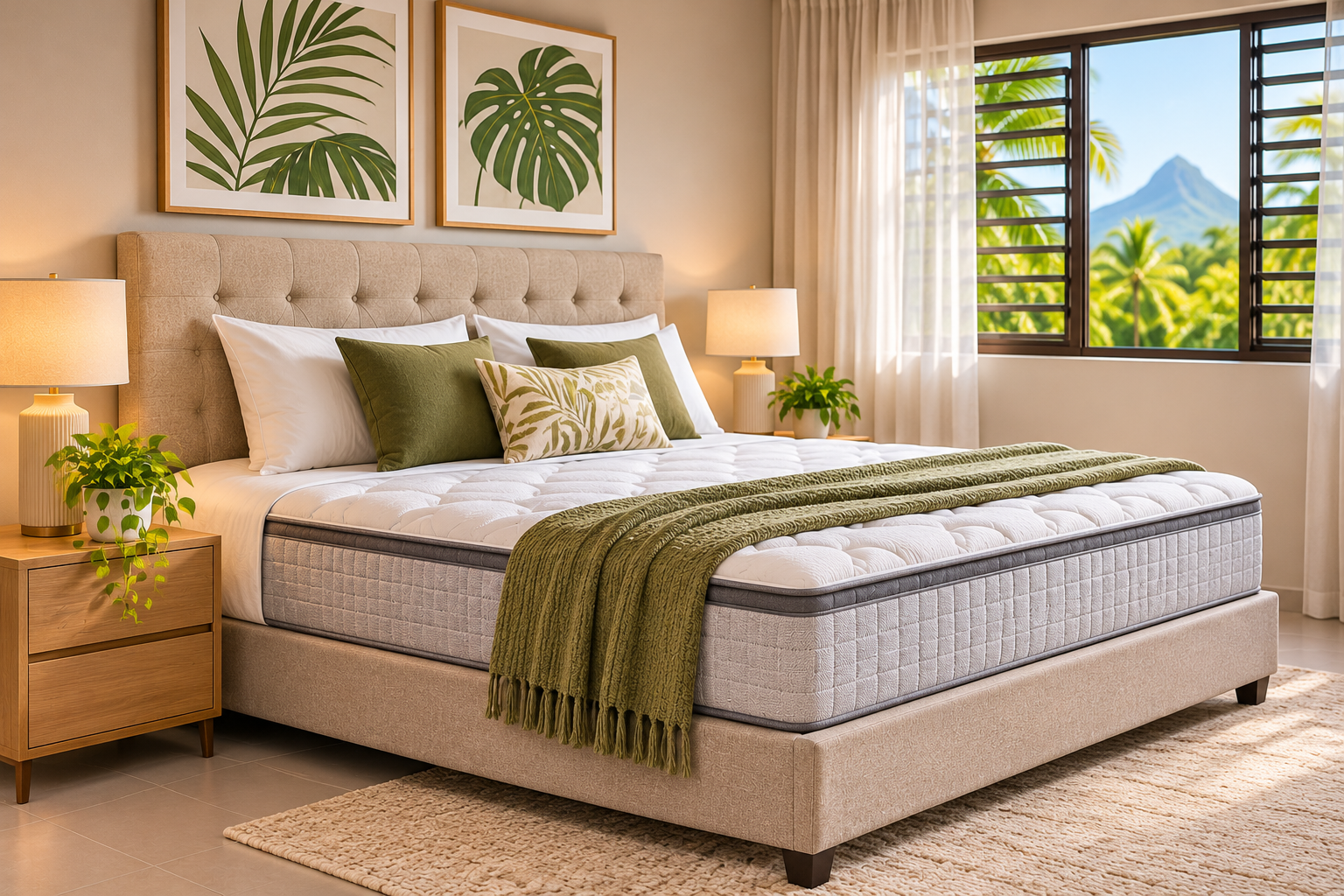
The right mattress, the right base, the right bedroom: better sleep every night.
Foam vs Pocket Spring Mattress: Which Is Right for You in Mauritius?
An honest buying guide to mattress types, comfort, climate and value, written for warm Mauritian bedrooms.
Two different ways to build a mattress. The right one depends on you.
Whether you're a newly married couple setting up your first bedroom or a family replacing a mattress that's past its best, choosing between foam and pocket spring can feel confusing. Many customers arrive at TFP believing every spring mattress is the same, or that every foam mattress is memory foam. Neither is true.
Pocket spring mattresses are currently the more popular choice among TFP customers, but interest in foam, especially memory foam and high-density foam, has grown a lot in recent years. This guide explains how each type works, how they compare in Mauritius's heat and humidity, and how to test a mattress properly so you choose with confidence.
What Is a Foam Mattress?
A foam mattress uses layers of foam to provide cushioning and support, without a metal spring core. There are several types of foam, and they behave very differently:
- Conventional polyurethane foam: the most basic and affordable foam
- High-density polyurethane foam: the most common foam in TFP's range, popular for durability at an accessible price
- High-resilience foam: springs back quickly after pressure, giving a more responsive feel
- Memory foam: reacts to body heat and pressure, slowly moulding around your body
Many foam mattresses combine different layers to achieve a particular feel. Foam mattresses come in soft, medium and firm options, so "foam" doesn't automatically mean soft. They're also generally lighter than pocket spring mattresses of the same size.
What Is a Pocket Spring Mattress?
A pocket spring mattress contains individual metal springs, each sealed in its own fabric pocket. Because each spring moves on its own, it responds to pressure more independently than traditional connected spring systems.
Not all spring mattresses are pocket spring mattresses. This is one of the most important differences to understand:
- Pocket springs: individually wrapped and moving independently
- Bonnell springs: hourglass-shaped springs joined together by wire
- Continuous coil: one long wire shaped into many springs
- Offset springs: another type of connected spring system
TFP's pocket spring mattresses include foam comfort layers above the springs. The springs provide the support, while the foam layers give the cushioning and surface feel. They're available across several price ranges and are generally more expensive than basic foam mattresses.
What About Hybrid Mattresses?
A hybrid mattress combines a spring support core with substantial foam or other comfort layers to balance support, cushioning and responsiveness. Since most pocket spring mattresses already have some foam, the term "hybrid" isn't used consistently. It usually describes mattresses with a thicker foam comfort layer, often 5 cm or more, rather than a thin padding layer.
TFP's Royal Lux range includes hybrid options, so confirm specific model details at tfp.mu or in-store. Hybrids sit in a higher price category and can suit couples with different comfort preferences, but they aren't automatically better than other types.
The Fundamental Difference
- Foam: support and pressure relief come from the properties and arrangement of the foam layers.
- Pocket spring: support comes mainly from individually pocketed springs, with comfort shaped by the layers above them.
Either type can be made to feel soft, medium or firm. Pocket spring isn't automatically firmer, and foam isn't automatically more comfortable. Comfort depends on the complete mattress design, not one material.
Foam vs Pocket Spring vs Hybrid at a Glance
| Factor | Foam | Pocket Spring | Hybrid |
|---|---|---|---|
| Support type | Foam layer properties | Individual spring response | Springs + substantial foam |
| Temperature | Can retain heat, depending on build | Generally more airflow | Varies |
| Motion isolation | Generally very good | Good (better than connected springs) | Good |
| Responsiveness | Varies (memory foam is slower) | Generally more responsive | Good |
| Edge support | Depends on construction | Can be reinforced | Can be reinforced |
| Noise | Silent | Can squeak over time | Varies |
| Price | Wide range, accessible entry point | Generally mid to higher | Generally higher |
| Best for | Quiet sleep, motion sensitivity, pressure relief | Warm bedrooms, responsive feel, couples | Couples, balanced preferences |
| Durability | Depends on quality | Depends on quality | Depends on quality |
The best way to choose: lie down, take your time, and test together.
Sleeping Cool in Mauritius's Heat
Sleeping temperature is one of the most common concerns we hear, especially during the warm season from October to April and in bedrooms without air-conditioning.
Pocket Spring and Airflow
Pocket spring mattresses are generally seen as sleeping cooler than dense all-foam mattresses. The open space inside the spring core lets more air move through the mattress. However, the comfort layers, cover fabric and overall design also affect temperature, so not every pocket spring mattress sleeps cooler than every foam mattress.
Foam and Heat
Some foam mattresses hold more body heat, especially dense memory foam. Open-cell and perforated foams allow more airflow, so ask about breathable options. Gel-infused foam can feel cool at first, but that effect fades once the gel warms to body temperature. It isn't a guarantee of a cooler night.
Your Bedroom Matters Too
- Mattress cover: a breathable knitted cover lets more air through than a thick quilted one. Selected TFP models have knitted covers, and some have removable covers.
- Bedding: cotton sheets and lightweight bedding help in warm weather.
- Fans and air-conditioning: a mattress that feels hot in a closed room may feel perfectly comfortable with a ceiling fan or AC.
- Ventilation: open windows and air movement make a real difference.
Humidity, Moisture and Mould
Humidity is a separate issue from heat. Moisture can build up under a mattress, especially in poorly ventilated rooms, against damp walls or in older homes with roof or wall leaks. Both foam and pocket spring mattresses can develop mould if moisture persists. No mattress type is mould-proof.
- Never place a mattress directly on the floor. Air can't circulate underneath, and moisture can collect.
- Use a suitable bed base that lets air flow underneath, and follow the manufacturer's bed-base requirements. Solid platforms may need ventilation openings.
- Choose the right protector. Waterproof protectors stop spills but can trap heat and moisture; breathable protectors allow more airflow but offer less liquid protection.
- Keep mattresses away from damp walls and ventilate the bedroom regularly where you can.
- Fix the cause first. If an old mattress has mould, check for roof leaks, condensation or damp before buying a new one, or the problem may return.
Firmness: Is Firm Really Best for Your Back?
Many people believe a firm mattress is automatically better for the back. It isn't that simple.
- Firmness is how soft or hard the surface feels.
- Support is how well the mattress keeps your spine in a comfortable, natural position.
A softer mattress can be supportive for some people, while a very firm mattress can create uncomfortable pressure at the shoulders and hips, especially for side sleepers. Firmness labels also aren't standardised. One brand's "medium-firm" can feel quite different from another's, which is why testing in person matters.
Your Sleeping Position
Not sure how you sleep? Think about the position you wake up in most often. Then test mattresses in that position.
| Sleeping position | What to prioritise |
|---|---|
| Side | Comfort at the shoulders and hips |
| Back | Balanced support and cushioning |
| Stomach | Avoiding too much sinking at the hips and midsection |
| Combination | Easy movement between positions |
These are general tendencies, not medical rules. Body shape, weight and personal preference all change what feels right.
Body Weight and Support
Heavier sleepers often prefer stronger support that keeps the surface even. Well-designed high-density foam and pocket spring systems can both do this. For springs, wire gauge, zoning and comfort layers all make a difference. Check manufacturer weight guidance where it's available.
Lighter sleepers often find the same mattress feels firmer, because they sink into it less. That's why couples with different body weights should always test a mattress together.
Foam or Pocket Spring: How to Choose the Right Mattress for Mauritius
Pressure Relief: Sleeping "In" vs Sleeping "On"
Memory foam is known for moulding around the body and spreading pressure. Some people love this; others dislike the sinking feeling and feel "trapped". Pocket spring mattresses can also relieve pressure well through their comfort layers.
- Sleeping "in" a mattress: deep, contouring foam that hugs your body
- Sleeping "on" a mattress: a more responsive surface that holds you up
Not all foam sinks. High-resilience and some open-cell foams are much more responsive than dense memory foam. Also, soft doesn't always mean good pressure relief: a firm mattress can relieve pressure well, while a soft one may not if its layers compress unevenly.
Motion Isolation for Couples
Feeling your partner move or get out of bed is a common sleep disturbance.
- Foam generally absorbs movement well, keeping it in one spot.
- Pocket springs can also isolate movement well, because each spring responds on its own.
- Traditional connected springs tend to pass more movement across the bed.
Foam doesn't always beat pocket springs here. A well-designed pocket spring mattress can perform just as well.
Edge Support
Many people sit on the edge of the bed to dress, and couples often sleep near the edges. Weak edges make the outer part of the mattress feel unstable, reducing the usable sleeping area. This matters especially on smaller doubles shared by two adults.
Pocket spring mattresses can have reinforced perimeter springs or foam edges, and some foam mattresses use firmer foam around the edges. Not every pocket spring mattress has better edge support. Selected TFP models have reinforced edges. Sit on the edge in the showroom and check that it feels stable.
Ease of Movement
Some memory foam responds slowly when you move, which can feel like resistance when changing position. Pocket spring mattresses generally feel more responsive and "buoyant", and high-resilience foam can feel responsive too. If you change position often during the night, this matters. When testing, roll from your side to your back and notice how easy it feels.
What Makes a Quality Mattress?
Foam Quality
- Density (kg/m³): higher density generally means more durable foam, but not necessarily firmer.
- Resilience: how quickly foam returns to shape. High-resilience and high-density describe different things.
- Terms like "premium foam" have no standard meaning, so ask about the actual foam specification. Density information is available for selected TFP models.
Pocket Spring Quality
- Wire gauge: thicker wire generally means more durable springs
- Spring count: more springs can give finer support, but more isn't automatically better
- Spring height and arrangement
- Zoning: different spring tensions for the shoulders, lower back and hips (ask which TFP models offer this)
- Edge reinforcement, including foam encasement around the perimeter
- Comfort-layer quality: this shapes much of how the mattress feels
Always look at the full specification, not just one headline number.
Airflow under and around the mattress keeps it fresh and comfortable.
Durability and Lifespan
Many people assume pocket spring mattresses always last longer than foam. That isn't reliably true. A high-quality foam mattress can outlast a poor pocket spring mattress, and the other way round. Both types can sag: foam through wear, and pocket springs through spring fatigue or comfort-layer wear.
Lifespan depends on material quality, body weight, how the mattress is used, ventilation, the bed base and maintenance.
Wondering if it's time for a new one? Read How to Know When It's Time to Replace Your Mattress in Mauritius.
Caring for Your Mattress
- Rotate as instructed. Follow your model's care instructions, as rotation intervals vary.
- Don't flip a one-sided mattress. Many mattresses are built to be used one way up only. Flipping can damage them and affect comfort.
- Use a mattress protector.
- Vacuum the surface according to the care instructions.
- Avoid soaking or steam cleaning unless the manufacturer allows it. Too much moisture can damage foam and internal parts.
- Keep the bed base clean and dry.
- Check for sagging: lay a straight edge, like a long ruler or spirit level, across the mattress to spot dips you might not see under bedding.
Noise
All-foam mattresses are silent because they have no metal parts. Pocket spring mattresses can develop squeaks over time, but the noise often comes from the bed frame, not the mattress. Check and tighten the bed frame's joints first. This often solves the problem without replacing anything.
Price and Long-Term Value
As a general guide at TFP:
- Basic foam mattresses are the most affordable starting point
- High-density and high-resilience foam mattresses sit in the mid-range
- Memory foam mattresses are typically mid to higher priced
- Entry-level pocket spring mattresses cost more than basic foam
- Premium pocket spring and hybrid mattresses, including the Royal Lux range, are at the top
Think about cost per year of use, not just the price tag. A well-made mattress that gives you many years of good sleep can be better value than a cheaper one you replace much sooner. That said, the most expensive mattress isn't always the best one for you. Check current prices on the mattresses page or in-store, and see our payment methods.
TFP's Royal Lux Range
Royal Lux is TFP's premium mattress range, including U Sleep, Royal Sleep and Sleepy Deep. Selected Royal Lux models may include a 10-year warranty, so confirm current model terms at the time of purchase. See our warranty and delivery pages for details, and read Mattress Trade-In: When (and Why) You Should Upgrade Your Sleep.
Which Should You Choose?
Foam may suit you if…
- You want a completely silent mattress
- You're disturbed by a partner's movement
- You like a contouring, hugging feel (memory foam)
- You want an accessible price
- Your bedroom has air-conditioning
- You prefer a surface without bounce
May be less suitable if…
- Your bedroom is warm with no AC (dense foam)
- You prefer a buoyant, responsive feel
- You change position often
Pocket spring may suit you if…
- Your bedroom is warm and you want more airflow
- You prefer a responsive, buoyant surface
- You want strong edge support
- You change position often during the night
- You like the traditional feel of a spring mattress
May be less suitable if…
- You and your partner have very different body weights
- Your budget doesn't stretch to a quality pocket spring build
For sizing, see King Size vs Queen Size Bed: Which Should You Choose in Mauritius? and Single Bed vs Double Bed: How to Choose the Right Size for Your Room. Comparing other options? Try Pillow Top Mattress vs Memory Foam: Which Is Better for Mauritius? and Best Mattress in Mauritius.
Real-Life Scenarios
These are illustrative examples, not actual TFP customer case studies.
A couple in a warm bedroom without air-conditioning
Both are light sleepers, and heat is their main concern. A pocket spring mattress with breathable comfort layers may give them the best airflow, and a hybrid with breathable foam is worth a look too. Dense memory foam on its own is likely to feel warm. They should test together in-store.
A single adult who changes position often
They want a surface that doesn't resist movement. High-resilience foam or pocket spring will likely suit them better than dense memory foam. The final choice depends on bedroom temperature and budget.
A couple with very different body weights
The lighter partner may find the mattress feels firmer than the heavier partner does. A zoned pocket spring or a layered foam mattress may suit both better than a uniform surface. They should test together, ideally lying in their usual sleeping positions at the same time.
10 Mistakes to Avoid When Buying a Mattress
- Not testing in your real sleeping position. Spend 10 to 15 minutes, not 30 seconds.
- Assuming firm is best. Very firm can cause pressure points.
- Choosing by spring count alone. Look at the full specification.
- Assuming pocket spring always sleeps cooler. Check the comfort layers and cover too.
- Assuming all foam is memory foam. There are several very different types.
- Ignoring bed-base requirements. The wrong base affects comfort and airflow.
- Forgetting your bedroom environment. Ventilation, fans, AC and bedding all matter.
- Buying the cheapest option without thinking long term. Compare value per year.
- Testing alone when you share a bed. Test together for motion and weight differences.
- Treating warranty length as comfort lifespan. They aren't the same thing.
Closing Thoughts
There's no single winner between foam and pocket spring. Each can be excellent, and each can disappoint, depending on how well it's made and how well it suits you. In Mauritius, think beyond the mattress itself: your bedroom's airflow, your bed base and your bedding all shape how you sleep.
Know your sleeping position, consider your bedroom's climate, and take the time to lie down and test properly, together if you share a bed. A mattress is something you use every single night. It's worth choosing carefully. Browse the mattresses and beds ranges, or visit a TFP showroom to try them in person.
Frequently Asked Questions
The Basics
What is the difference between a foam and a pocket spring mattress?
A foam mattress gets its support from layers of foam, while a pocket spring mattress gets its support from individually wrapped metal springs topped with comfort layers. Either can feel soft, medium or firm.
Is a pocket spring mattress the same as a regular spring mattress?
No. Pocket springs are individually wrapped and move independently, while traditional systems like Bonnell springs are connected and tend to pass more movement across the bed.
Are all foam mattresses memory foam?
No. Foam mattresses can use conventional, high-density, high-resilience or memory foam, and each feels and performs differently.
What is a hybrid mattress?
A hybrid mattress combines a spring support core with substantial foam comfort layers to balance support, cushioning and responsiveness.
Climate and Comfort
Which mattress is best for hot weather in Mauritius?
Pocket spring mattresses generally allow more airflow than dense foam, but the cover, comfort layers, bedding and room ventilation matter just as much. Test options and consider your bedroom setup.
Does memory foam sleep hot?
Dense memory foam can hold more body heat than other materials. Open-cell or breathable foams, a knitted cover, cotton bedding and a fan or AC all help.
How do I stop my mattress from getting mouldy?
Keep it off the floor on a ventilated bed base, away from damp walls, and ventilate the bedroom regularly. Both foam and spring mattresses can develop mould if moisture persists.
Is a firm mattress better for my back?
Not always. A mattress should support your spine without causing pressure points, and a very firm mattress can be uncomfortable, especially for side sleepers.
Couples
Which mattress is best for couples?
Both foam and pocket spring can isolate movement well. Couples should test together, check edge support and consider a zoned or hybrid mattress if their body weights differ a lot.
Will I feel my partner move on a pocket spring mattress?
Usually much less than on a traditional connected spring mattress, because each pocket spring moves independently. Test it in-store by having one partner move while the other lies still.
Quality and Value
Does a higher spring count mean a better mattress?
Not on its own. Wire gauge, spring height, zoning and comfort-layer quality all affect how a pocket spring mattress performs.
Does higher foam density mean a firmer mattress?
No. Density measures how much material is in the foam, while firmness describes how it feels. High-density foam can feel soft.
Do pocket spring mattresses last longer than foam mattresses?
Not necessarily. Lifespan depends on quality, use, ventilation, the bed base and care, and a good foam mattress can outlast a poor spring mattress.
How long should I test a mattress in the showroom?
Aim for 10 to 15 minutes, lying in your usual sleeping position, and roll from side to back to check how easy it is to move.
Does TFP offer a warranty on mattresses?
Yes. Selected Royal Lux models may include a 10-year warranty. Confirm the current terms for your chosen model at the time of purchase.
The right mattress, the right base, the right bedroom: better sleep every night.